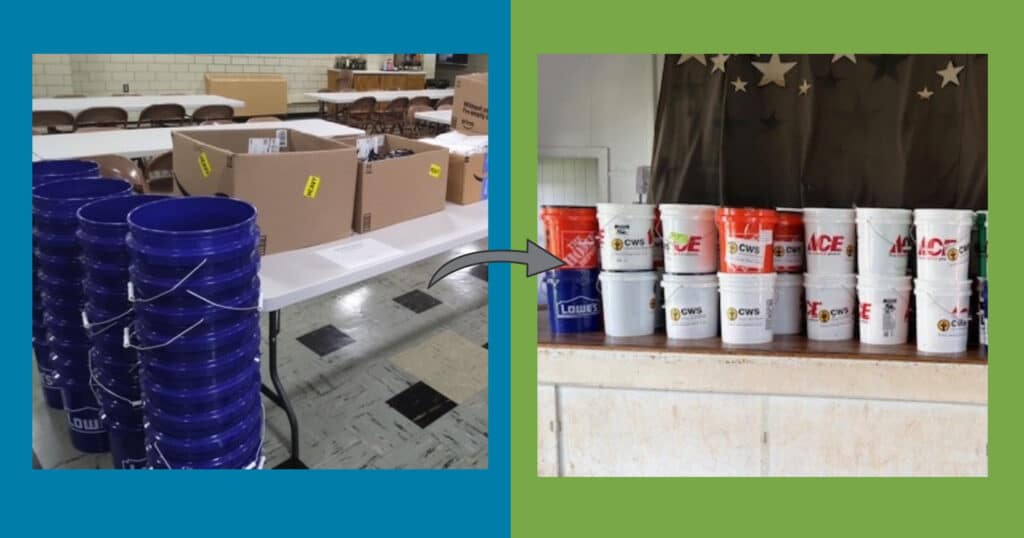
The life cycle of CWS clean-up buckets: Congregations support flood response from Hawaii to Ohio
In April, 100 emergency clean-up buckets arrived at Ewa Community Church UCC in Oahu in an effort to aid flood recovery efforts there.
This followed Hawaii’s historic flooding in March, and in its wake, Ewa Community Church has served as a hub for collecting and distributing food and supplies to flooded areas of Oahu, said the Rev. Kahu Rennie Mau, the congregation’s senior pastor.
The church’s location on high ground near a highway in western Oahu, its parish hall with storage space, and it’s strong relationships with community groups situated it as a crucial site for coordinating community disaster response, Mau said.
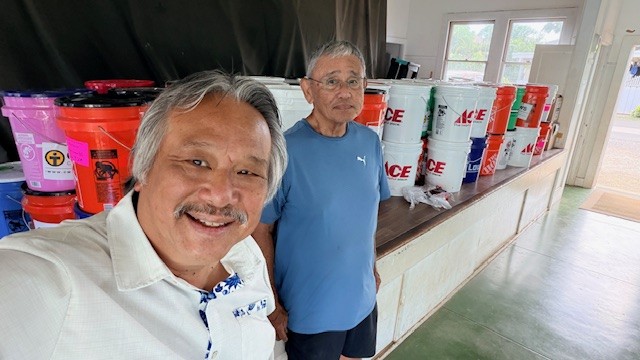
When the 100 clean-up buckets arrived there in April, which were sent in partnership between Church World Service and UCC Global HOPE, about 30 were distributed to folks in the community, Mau said. Each bucket is packed with cleaning supplies shown to be useful in disaster clean-up.
“What was nice is when the people saw the name on each bucket of where they came from, we could see the bigger picture of the support that came. That was really special,” Mau said.
Bucket storage as disaster prep
Because of the time it takes to transport items, like the clean-up buckets, to Hawaii, much of the initial clean-up work was done before they arrived. Danny Tengan, disaster response coordinator for the Hawaii Conference UCC, described how muck-out work took place quickly with “neighbors helping neighbors” in the weeks following the flooding.
Tengan has plans to store the remaining buckets in several additional regions of the island to decentralize where supplies are available, given the way that disasters can restrict access between different areas.
And Tengan hopes to develop a clean-up bucket program within Hawaii Conference UCC. “It gives our congregations something to do, something to prepare for,” he said.
“As we have continued to see a nationwide increase in the frequency and severity of disasters, it’s important to make sure all communities are well-prepared,” said Katie Howe, UCC’s minister for Disaster Response and Recovery.
That’s why a UCC Global HOPE grant is available to help amplify the amount of clean-up buckets and other CWS kits that any one congregation can create, Howe said. It functions as a simple, rolling application, where churches can apply once per calendar year for a $250 matching grant.
Churches who make disaster kits happen
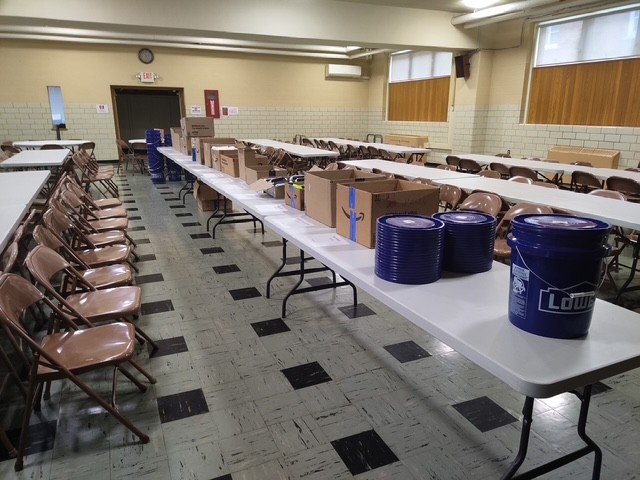
In St. Mary’s, Ohio, St. Paul’s UCC created 50 clean-up buckets and 400 hygiene kits earlier this year. They are one of many UCC congregations participating in a CWS kits ministry.
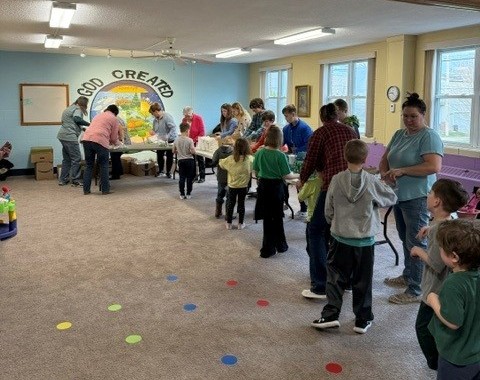
The congregation’s children assembled the hygiene kits during Sunday school with work stations set up for them, said church member Jill Dickman. A separate event invited people into the fellowship hall to assemble the clean-up buckets following worship. Church volunteers then delivered them to a CWS Kit Drop-off Location in Marysville.
St. Paul’s UCC received two grants – one from UCC Global Hope and another from the Northwest Association of the Heartland Conference UCC – to add to the $2,000 in donations from the congregation, Dickman said. This enabled them to make 20 more clean-up buckets than the previous year, she said.
“There have been a lot of disasters in nearby communities and states, and I think everybody was feeling kind of blessed it wasn’t us, but wanting to help our neighbors in need,” Dickman reflected. “Because they’re assembled ahead of time, it seems they can be distributed quickly when there is a time of need.”
Kits create hands-on community-building
In the wake of disasters, people are often interested in doing something tactile and hands-on, Howe said, which makes the clean-up buckets and hygiene kits the perfect option. CWS offers specific guidelines of all items to be included in each bucket or kit.
“Although buckets being built today might not go to the disaster happening right now in the news, know that there are buckets and kits already on the way. The warehouses are getting depleted, and we need to replenish the warehouse so when the next disaster happens, there are already some on hand,” she said.
One focus of the UCC Global HOPE matching grant is that it includes recipients hosting an event to assemble the buckets. This creates an important way to engage community and build education around disaster preparedness — and it’s great for involving youth, Howe said.
CWS even offers Kit Party Packs where groups can receive all the supplies ready for the group to begin packing them.
Money is always needed in disaster response, Howe said, and she thinks it’s important to remember that many other kinds of physical donations often don’t get used.
“The CWS kits are a tangible way to offer something useful in the wake of disaster,” Howe said. “I think it’s a great opportunity of neighbors helping neighbors and how we directly support communities that have been affected.”
✅Learn more about assembling Church World Service kits here.
✅Find information about the Global HOPE Kit Matching Grant here.
Content on ucc.org is copyrighted by the National Setting of the United Church of Christ and may be only shared according to the guidelines outlined here.
Related News

We Are Not Alone
A Tent of Our own Making is a series of gatherings in the United Church of Christ where...
Read More
Reporter’s Roundtable: Citizens Bank, Antoinette Brown, Church and buildings, and Club West
UCC News recorded a special, live edition of the Reporter’s Roundtable featuring some of the...
Read More
As Chicago Theological Seminary ends 170 years of educating ministry leaders, talks to affiliate with Yale Divinity School get underway
Chicago Theological Seminary (CTS) and Yale Divinity School (YDS) have announced a proposed...
Read More