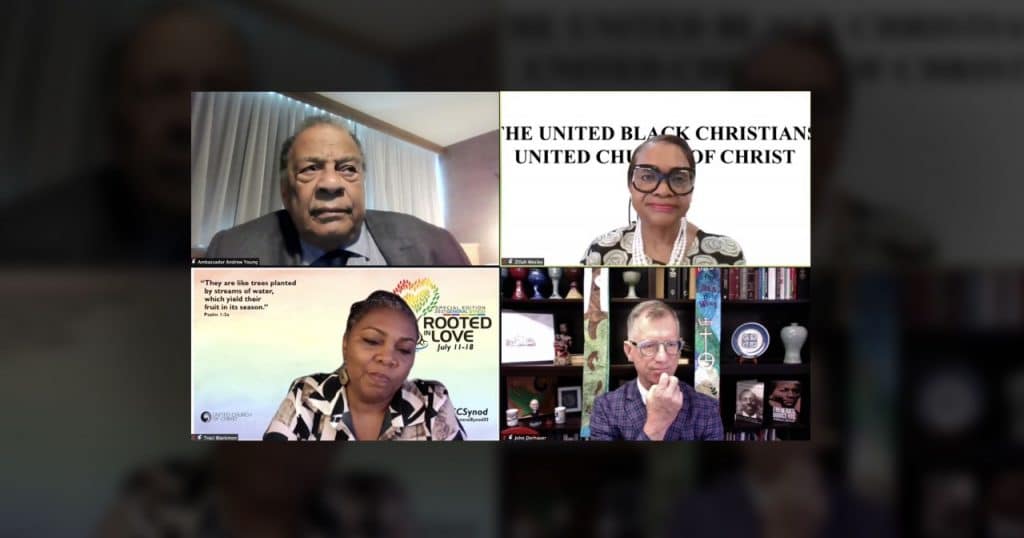
Andrew Young offers behind-the-scenes glimpses of the Civil Rights Movement
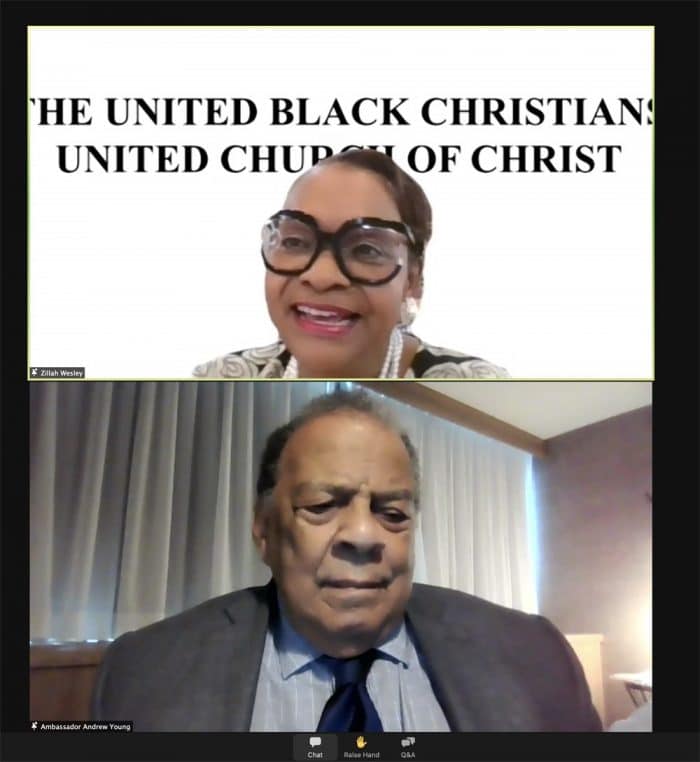
“Stay calm, stay cool, and you can think with anybody.”
The Rev. Andrew Young, born Andrew Jackson Young Jr., grew up in New Orleans in the neighborhood surrounding the Central Congregation Church.
“That was the mantra I was raised on in that integrated neighborhood — integrated until it came time to go to school,” Young continued, affirming bits of wisdom he attributes to his father.
Young spoke July 12 to United Black Christians at a General Synod 33 event celebrating the UBC’s 50 years of ministry in the United Church of Christ. The Rev. John Dorhauer, general minister and president, referenced Young’s many titles, including Reverend, Ambassador, Congressman, Mayor and — Dorhauer’s favorite — Co-Chair of the 1996 Olympic Games in Atlanta.
Born into the church
“I would contend that I was born into this church, 89 years ago, when I started Sunday School at Central Congregational Church in New Orleans,” Young said. He spoke of his parent’s education at Straight College, a school that later merged with New Orleans University to form Dillard University. He repeatedly reminded listeners of the significance of the American Missionary Association — an affiliate of the Congregational Church whose work continues today in the national ministries of the UCC — and its impact on the present-day Black middle class.
The elder statesman smiled as he shared “the unconventional ways I came to the things I’ve been able to do.” One example emerged in a story involving the SAT college entrance exam he took as the only Black person in a large auditorium filled with white students. He later discovered that his test was never processed. After being overlooked by the schools on his list of initial preferences, he ended up at Howard University, and in hindsight, acknowledged his gratitude. Young noted that he now holds honorary degrees from most of the schools that formerly rejected him.
“Much of Black America comes out of the church,” Young said, as he reflected on what we see happening around the planet today. The schools and colleges, founded after the Amistad Rebellion of 1839, provided teachers and open colleges. “The Black middle class in America, as we know it, is in large measure the result of educational opportunities that came out of the American Missionary Association.”
Being the church in the world
Young told listeners of encounters with the Ku Klux Klan and reflected on his work with the Rev. Dr. Martin Luther King Jr. He was a pastor in southern Georgia when he became active in the Civil Rights movement, organizing voter registration drives in 1954 in the face of death threats. Young was both a strategist and a negotiator during campaigns that led to the passage of the Civil Rights Act of 1964 and the Voting Rights Act of 1965.
In 1972, Young was elected to Congress, becoming the first African-American representative from the Deep South since Reconstruction.
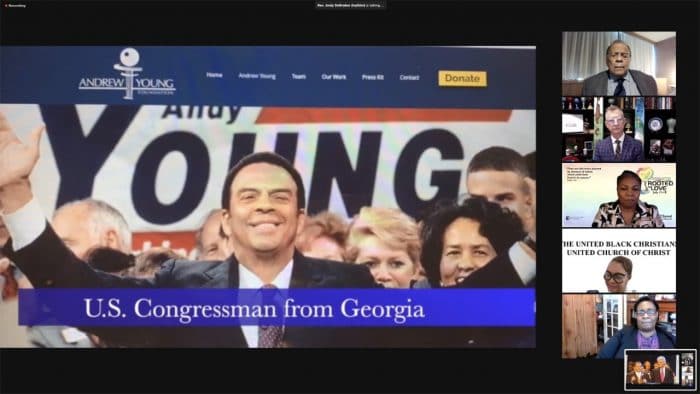
He expressed his tension with living out church in the middle of society. And he described himself foremost as an ambassador, always listening, negotiating, bringing people together for the betterment of society.
He unapologetically pushes back on contemporary conversations around “white privilege,” because, he said, “There are few people more privileged than me. I’m not passing that [white privilege] on as a burden to white people alone. … White supremacy is a sickness, and you don’t get angry with sick people.”
A story of ‘firsts’
Andrew Young spoke of “firsts” of the UCC, but did not mention that he himself had been one — as keynote speaker at the first UCC National Youth Event on the campus of Carleton College in 1980. He did reference his time of transition, moving from serving as U.N. ambassador to becoming mayor of Atlanta. “I had a world view when I went to Atlanta. We built an airport. We raised money for the Olympics.”
He also spoke about the worldview of the UCC.
“We have been on the cutting edge of Christianity, behind the scenes, fulfilling what Martin Luther King adopted as his mission, mission with the SCLC (Southern Christian Leadership Conference) to redeem the soul of America.
“We would not have had a civil rights bill in 1964,” Young said, without the work of the UCC and its ecumenical partners. “It was actually the Council on Religion and Race that sat down with members of Congress and senators and found enough votes to break the filibuster in 1964.
“Redeeming the soul of America is still the way I see our mission now.”
C.L.”Curly” Stumb, editor of the UCC Southern Conference E-news, is a General Synod Newsroom volunteer.
Related News

We Are Not Alone
A Tent of Our own Making is a series of gatherings in the United Church of Christ where...
Read More
Reporter’s Roundtable: Citizens Bank, Antoinette Brown, Church and buildings, and Club West
UCC News recorded a special, live edition of the Reporter’s Roundtable featuring some of the...
Read More
As Chicago Theological Seminary ends 170 years of educating ministry leaders, talks to affiliate with Yale Divinity School get underway
Chicago Theological Seminary (CTS) and Yale Divinity School (YDS) have announced a proposed...
Read More