When Justice Never Comes
What would you do if your family was given 20 minutes to clear out of your house while military personnel pointed guns at your children?
That was the horror one family in the West Bank of Palestine faced. When Israeli military forces showed up at their home’s doorstep, they didn’t have the luxury of thinking carefully about what they would take with them. They were simply told to be gone in 20 minutes. The military was seizing the house to use as a base of operations for their raiding of the refugee camp nearby. In a state of panic, the parents rushed to gather up their 6 children and whatever personal items they could manage. In the chaos that ensued, they did not realize that their daughter was still in her bedroom, the headphones fastened squarely on her ears drowning out the sounds of terror swirling all around her.
When the Israeli military entered the house, they found the little girl. Then they took her from the sweet sanctuary of her home’s bedroom and dropped her on the hood of their military vehicle. As they entered the refugee camp to conduct their raids, the 9-year-old child clinging to the vehicle in sheer terror became their human shield. They used her to deter Palestinians inside the camp from resisting them in any way. And when they were done with the day’s military operation, they discarded her, her usefulness to them concluded. She was alive but her life was forever changed.
Imagine the trauma that little girl experienced, and that of her family when they realized what had happened. Imagine the trauma of an entire community. And then multiply this one story and one community by the thousands over endless years of occupation.
It would be a grievous mistake to think the story I’ve shared here is an exception to the rule. It is not. While our eyes have been trained on the devastation of the war in Gaza, where over 72,000 Palestinians have been killed and more die every day from starvation and illness amid a fragile “ceasefire”, the situation in the West Bank of Palestine has also been deteriorating. At least 1200 Israeli “checkpoints” prevent access of Palestinians to jobs, fields, and families. The economy is in a shambles. Raids by the Israeli military for no discernible reason are commonplace, terrorizing whole communities. Israeli settlements continue to expand, squeezing out the Palestinian population on the little land they have left, and settler violence is widespread and unrestrained.
Generational trauma runs deep and wide here, but mental health supports are few and far between. That fact, and a true calling to empower the Palestinian people and communities, was the inspiration for Rami Khader to start “Anar” two years ago.
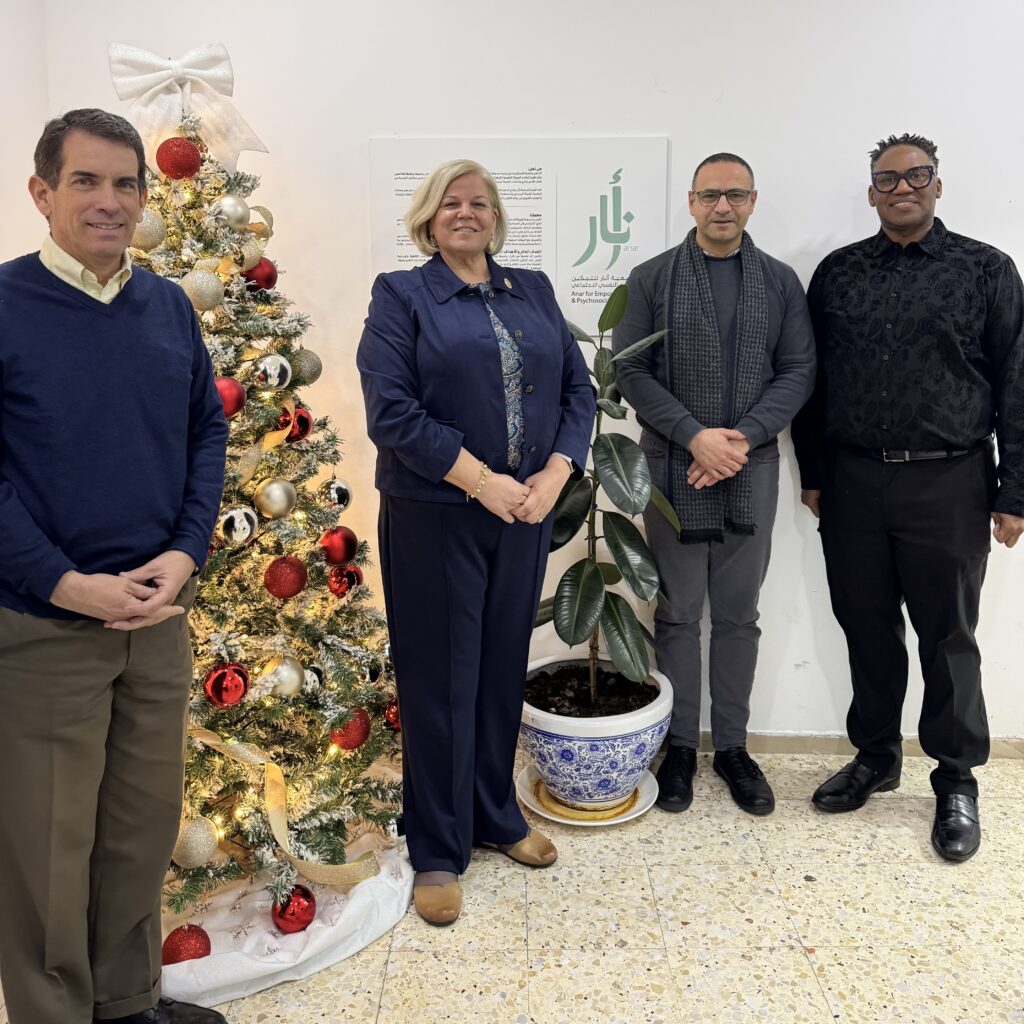
“Anar” means to light up, or bring the good news. The goal of Anar is to empower communities to address psychosocial needs through community-based self-help hubs, provision of professional counselors, and training of facilitators in local communities to lead activities designed to improve mental health. A core conviction for the organization is that those who are actually from the community are in the best position to serve the community. Anar has 14 staff members and has trained 300 facilitators in its first two years alone; another 150 facilitators will be trained in 2026. Global Ministries has been pleased to provide financial support for Anar’s ground-breaking work.
When we met with Anar’s founder, Rami, during our recent visits, he shared with us the story I detailed above as just one example of the chronic trauma being experienced by Palestinian families. The diagnosis of “Post-Traumatic Stress Disorder” doesn’t really apply here, he said, because trauma is a daily, never-ending experience; there is never an “after”.
What Anar does, Rami said, “is not really about ‘healing’. It’s really hard to find healing in a system where there is never any justice. But our task is to give some bit of hope that perhaps some day healing will be possible.” But Rami was quick to add: “Just saying ‘hope’ without giving people the tools [to deal with their circumstances] is not enough. We must walk with communities, be with the people. Accompaniment is our task.”
While Anar serves all and does not proselytize or focus only on Christians, it’s clear that its founder’s own Christian faith calls him to do this work. It sustains him personally and shapes the nature of Anar’s work. “The way I see Jesus is not as neutral. I see him with the oppressed, the weak, the suffering. If churches don’t speak truth to power, that is not faith. We must share the love of Christ through the work we do.”
Learn more about Anar and about our Global Ministries partners and presence in Palestine and Israel.
The Reverend Shari Prestemon began her service with the national ministries of the United Church of Christ in January 2024. As the Associate General Minister & Co-Executive for Global Ministries she has the privilege of overseeing several teams: Global Ministries, Global H.O.P.E., Public Policy & Advocacy Team (Washington, D.C.), and our staff representative to the United Nations. She previously served as pastor to local UCC congregations in Illinois and Wisconsin; the Executive Director at the UCC’s Back Bay Mission in Biloxi, Mississippi; and as Conference Minister in Minnesota.
Related News
Courage Among Us
“I hereby command you: Be strong and courageous; do not be frightened or dismayed, for the...
Read More
War & The Valley of the Shadow of Death
It has been just 11 days since the first strikes of the Israeli and U.S. military rained...
Read More
A Crisis of Hope
It was the most striking, and most sobering, part of our visits with partners in Palestine...
Read More