The Case for Public Action: A Matter of Faith
All is not well.
Our elected leaders in Washington, D.C. have been making a lot of decisions with disastrous consequences. The imposition of tariffs are driving costs up for American consumers, particularly food prices, which is deepening food insecurity across the country and causing economic distress. Our behavior around the world is also deeply concerning. Our actions in Venezuela and the current talk to “acquire” Greenland either the “easy way or the hard way” are only two examples of many that are eroding relationships globally and making us an unreliable ally, which has severe implications for our own security and threatens peace worldwide. And then there’s Minnesota, and the brutal killing of 37-year-old Renee Good, and the terror tactics being utilized by U.S. Immigrant & Customs Enforcement (ICE) officers in communities across the country against immigrants, U.S. citizens, protesters, and racially profiled individuals.
The pain and the horror of it all is wrenching.
But I can already hear the grumbling. “Why does she/the Church always have to get into politics? The Church shouldn’t have anything to do with politics.”
Please. Stay with me.
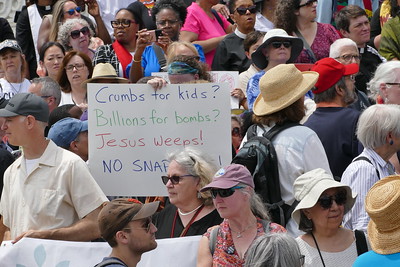
Our country’s political structures and the politicians we elect to work within them determine policy and practices that shape a national ethos and tell a story about who we are and what we care about. When that story contradicts every value we hold dear as people of faith, our efforts to summon change are genuine testimonies to our faith. We protest in the streets, or do public policy advocacy, or issue a statement that challenges an action of our government because we care about the kind of nation and world we’re building, because we want the story we tell to be one of justice and mercy, possibility and peace.
That’s not just politics. It’s a matter of faith.
A blog doesn’t allow space for making a lengthy theological case. But let me briefly name four reasons why speaking up, showing up in protest, and being fierce advocates for change are requirements of our faith.
Love is central to the teachings of Jesus and the living of our faith.
When Jesus was asked to name the greatest commandment, he responded: “ ‘You shall love the Lord your God with all your heart and with all your soul and with all your mind…’ And a second is like it: ‘You shall love your neighbor as yourself.’ On these two commandments hang all the Law and the Prophets.” (Luke 22:34-40) As people of faith, we cannot look away from circumstances where hatred rules, where violence rages, where our neighbor is harmed. We must lead with love and insist on it.
Prophetic courage is core to our faith’s ancient testimony.
Our sacred texts provide ample examples of prophets who named injustice clearly and boldly. Their voices spoke to their historical contexts, modeling the importance of speaking truth to power. They remind us that our mandate as people of faith includes building a world where “justice roll[s] down like waters, and righteousness like an ever-flowing stream.” (Amos 5:24) We must examine our modern-day context too, and speak as the prophets did.
Confession is an essential practice of our faith.
Our faith teaches us that we must be willing to reckon with our own sins against God and God’s people. That’s true on an individual level and in a broader, communal sense. When we harm one another, when we ignore or contribute to others’ suffering, we must acknowledge and confess it. It’s the only path toward the healing and redemption we need. Calling for accountability and inviting a turn in a new, more healthy and just direction are acts of faith.
Being faithful demands active participation in building relationships and communities rooted in love.
The example of Jesus leaves no room for arguing that fact. He called us into relationship and commissioned us to live lives worthy of the Good News. He actively welcomed the stranger, extended mercy to the marginalized and outcast, brought healing to the hurting, and questioned the status quo. He gave it all for the sake of love. People of faith cannot be passive bystanders to injustice and suffering. We must participate in building the beloved community now.
This week we celebrated the life and witness of Dr. Martin Luther King, Jr., a servant leader who knew that bending that arc of the moral universe toward justice required public action and unwavering faith. Today, in cities and rural communities across this country, people of faith are similarly waging protests, caring for the fearful, keeping vigil at schools and in neighborhoods, and demanding change with the courage of the prophets.
This is the story we have to tell, a narrative of love that refuses to be silenced, a testimony of faith that ventures outside the church’s door and into the streets. May it always be so.
The Reverend Shari Prestemon began her service with the national ministries of the United Church of Christ in January 2024. As the Associate General Minister & Co-Executive for Global Ministries she has the privilege of overseeing several teams: Global Ministries, Global H.O.P.E., Public Policy & Advocacy Team (Washington, D.C.), and our staff representative to the United Nations. She previously served as pastor to local UCC congregations in Illinois and Wisconsin; the Executive Director at the UCC’s Back Bay Mission in Biloxi, Mississippi; and as Conference Minister in Minnesota.
Related News
Courage Among Us
“I hereby command you: Be strong and courageous; do not be frightened or dismayed, for the...
Read More
War & The Valley of the Shadow of Death
It has been just 11 days since the first strikes of the Israeli and U.S. military rained...
Read More
A Crisis of Hope
It was the most striking, and most sobering, part of our visits with partners in Palestine...
Read More