Peace at the polls: UCC clergy and laity show up on Election Day, providing calm for the anxious and agitated
When the Rev. Allison Smith arrived at Lewiston, Maine’s polls for early voting, it wasn’t to cast her ballot. The senior pastor of the Congregational Church in Cumberland was there as a poll chaplain, responding to voter intimidation concerns.
“We had become aware of an extremist news outlet harassing voters as they were going into the polls,” said Smith.
Smith acquired de-escalation skills from her poll chaplaincy training offered by Multifaith Justice Maine. Still, no amount of training could truly prepare one for the “quite concerning” picture the pastor saw.
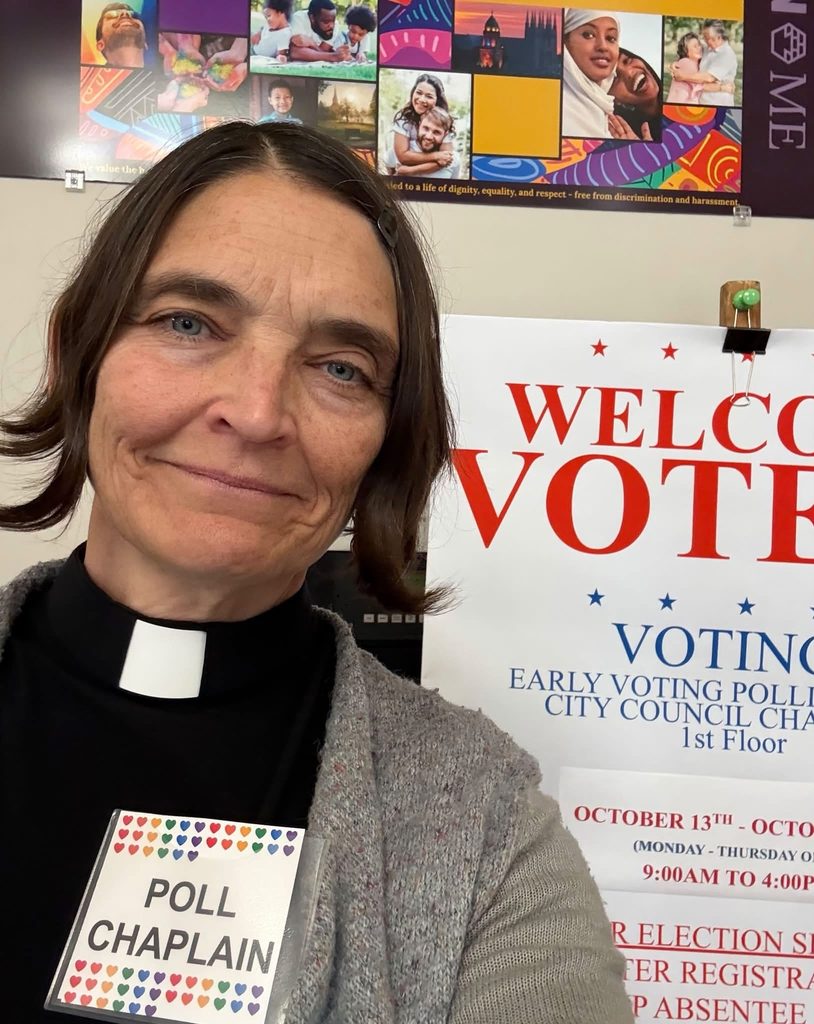
“Immigrants who came to the area decades ago, now citizens, were being viewed with suspicion,” said Smith. “All I kept thinking was throughout history people have fought for their right to vote — women, Black Americans, Native Americans — and now, rather than having it be a celebratory process of exercising civic duty, it has become fearful.”
On Nov. 3, she put her “chaplain” badge back on and was back at the polls, providing a “non-partisan, peaceful presence,” Smith said, 100 feet from the voting epicenter as required by election law.
Seeking peace as danger escalates
Like Smith, United Church of Christ pastors and laity have heeded the call to be the calm amid a growing political storm, training as poll chaplains for the 2026 midterm elections.
While it’s a seemingly new ministry among mainline denominations, brought on by the distrust and discord of the 2020 elections, poll chaplaincy is a movement rooted in the Black church’s fight for voter equality.
It’s also a ministry showing no signs of disappearing from the pastoral lexicon anytime soon.
“Over the past couple election cycles, there has been a marked increase in reports of harassment and intimidation at polling places,” said the Rev. Michael Neuroth, Director of the UCC Office of Public Policy & Advocacy in Washington, D.C.
During the 2024 election, the Bridging Divides Initiative (BDI) tracked over 170 election-related threats directed toward poll workers or other officials, a significant increase from previous years. More recently, a Pew Research Center study found that 85% of U.S. adults believe politically motived violence is increasing.
“There is growing concern that these trends will continue to intimidate or discourage voters in the 2026 midterm election, as we have witnessed government officials threatening the deployment of ICE and National Guard to ‘protect’ polling places, which is illegal according to federal law,” said Neuroth, adding, “Given these and other threats, it is essential that people of faith and conscious work to protect our democracy by leveraging our moral power in various ways.”
One way Neuroth’s team has leveraged such power was to team up again with Faiths United to Save Democracy, offering training for both ordained ministers and laypeople on how to show up at polling places where threats are high. Ordained ministers are designated “chaplains,” while laypeople are “peacekeepers.”
A congregation prepares for the polls
It was a training Rock Spring Congregational UCC in Arlington, Virginia embraced.
“Becoming a poll chaplain was a call our members answered immediately,” said the Rev. Laura Martin, Rock Spring’s associate pastor.
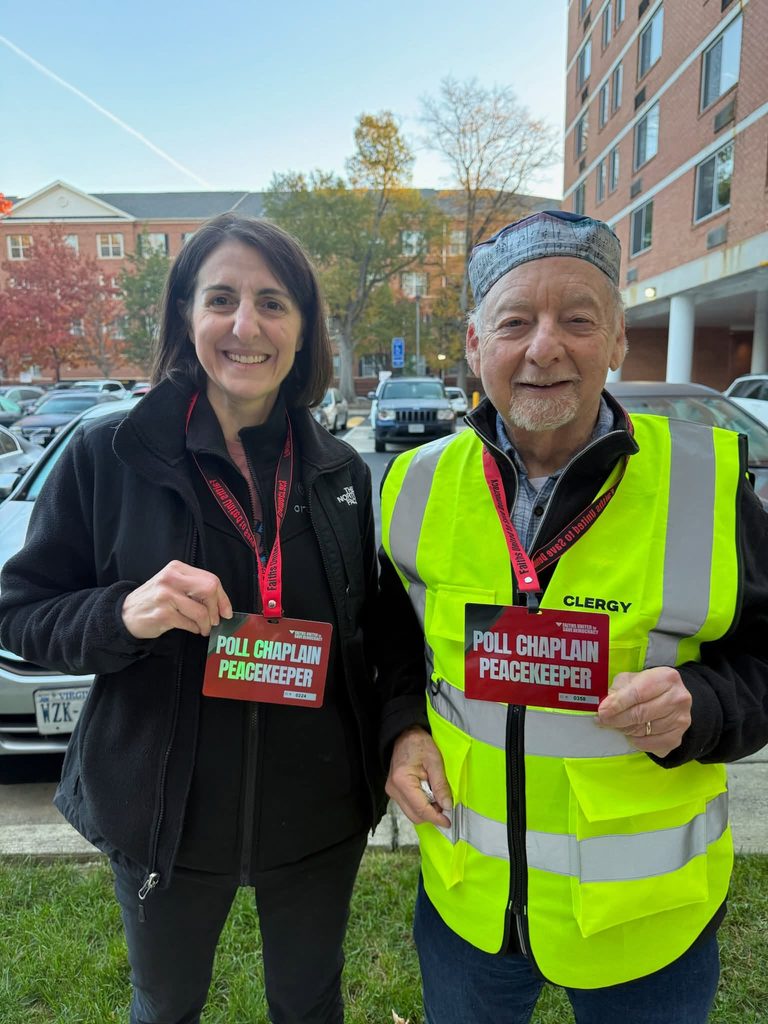
Martin, along with 12 church members, joined 400 other clergy and laity from various denominations for a 90-mintue Zoom poll chaplain training session, in which scenarios for what could happen at the polls were presented and appropriate responses were discussed.
“We covered what to do if ICE showed up at the polls, who to call, how to handle voter intimidation and disruptions,” said Martin.
What the pastor especially appreciated was the advice to call upon the power of music — singing hymns — to diffuse disrupters.
Pastoral presence is appreciated
According to the Rev. Breanna Illéné, Director of Ecumenical Innovation and Justice Initiatives for the Wisconsin Council of Churches in Madison, de-escalation skills are vital ones to acquire as “there are people who are trying to provoke.”
“We train clergy and laity to explore what it means to remain that calm presence,” said Illéné. “Poll chaplains are another set of eyes on the scene.”
It is that reassurance that another person is looking out for voters is what people are grateful for.
“Everyone’s context is different, but overall, the sight of poll chaplain is a positive thing. People tend to be thankful for them,” said Illéné.
The Wisconsin Council of Churches has tripled the number of poll chaplains for the 2026 midterms, training 180 people to deploy to polls identified as possible hotspots for conflict. The rise in poll chaplains is partly due to the council opening its training to laypeople, said Illéné.
A sacred act
In preparation for Election Day, Martin and her team of newly trained poll chaplains sat down to not only review what they learned during the Zoom training, but to brainstorm more scenarios that might arise at the polls.
“We must go into a situation with a lot of unknowns. We wanted to be prepared,” she said, naming out loud the truth that “apprehension does exist.”
It is a situation, though, that people of faith are called to enter.
“In Hebrew, the word for voice and vote is the same. Blessed are the peacemakers calls us from passivity into action,” said Martin.
The pastoral team at Orchard Ridge United Church of Christ in Madison, Wisconsin, share Martin’s view.
Weeks leading up to the election, a letter went out to the congregation, citing, “As people of faith, we show up to participate in our democracy because voting is a way that we attempt to create a society that is more just and loving for all people; a society where no one is left behind, and every person is cared for with dignity, because each one of us is a beloved child of God. Ultimately, voting is an act of living out our values as we seek to follow the way of Jesus together.”
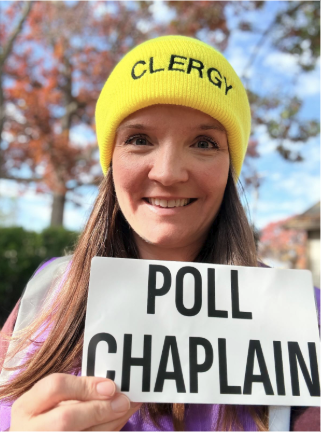
Two of the pastors, the Rev. Julia Burkey, senior minister, and the Rev. Kate Mackey, associate pastor for youth and children, are trained poll chaplains, donning their “uniforms” — caps and vests that read “chaplain” — to report to their assigned polls.
Are poll chaplains here to stay?
For Illéné, her motto to “make elections boring again” is one she knows is a long way from becoming reality.
“One election, two elections, it is going to take time to rebuild trust in our democracy. We are broken. It is not going to happen overnight,” she said. “The need for poll chaplains is here to stay.”
And long after the 2026 midterm election polls close, Illéné sees the skills acquired from poll chaplain training being used in other situations.
“It is beautiful for clergy to see what it means to be clergy in a public space,” she said. “Many have used their poll chaplain gear, their hats and vests, at other gatherings where a calming presence was needed.”
As for Neuroth, who is serving as a poll chaplain in Alexandria, Virginia — lending a peaceful presence wearing his clerical collar and a UCC Vote with Love t-shirt — his hope is for hundreds of people of faith show up for the election in love.
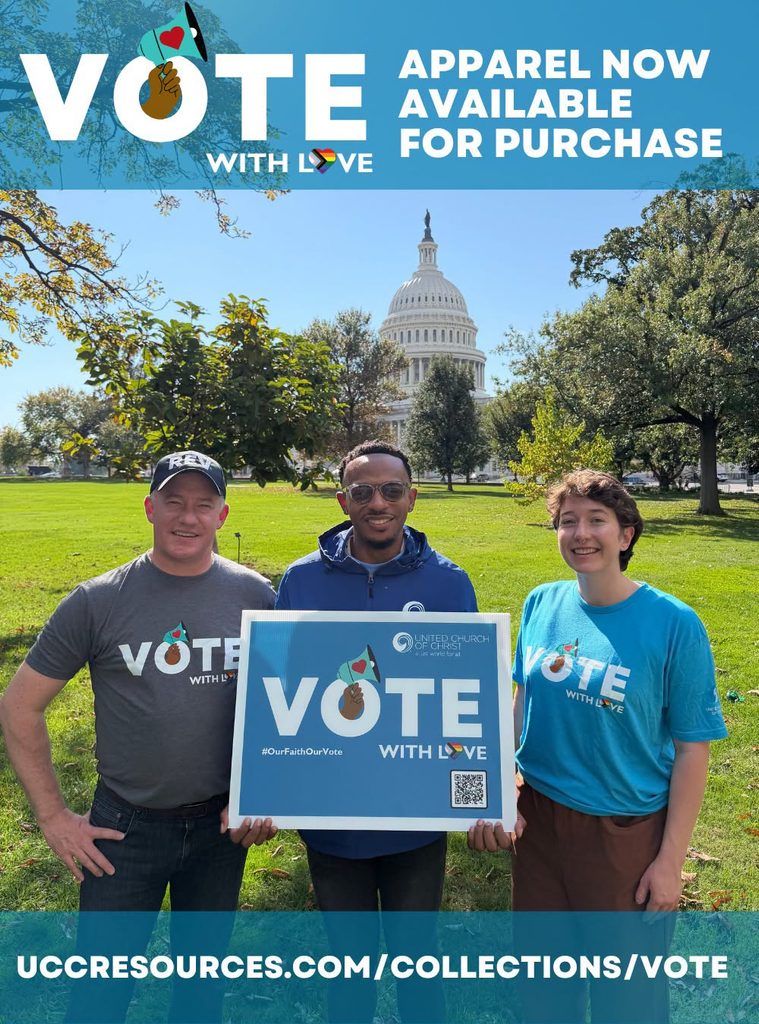
Like Illéné, Neuroth, too, sees the need for poll chaplains continuing into the near future.
“I encourage more UCC advocates to consider being trained to become poll chaplains and peacekeepers as we look to 2028,” he said.
Content on ucc.org is copyrighted by the National Setting of the United Church of Christ and may be only shared according to the guidelines outlined here.
Related News

What’s Next?
Midterm elections are here, with high stakes and potential shifts in power causing anxiety and...
Read More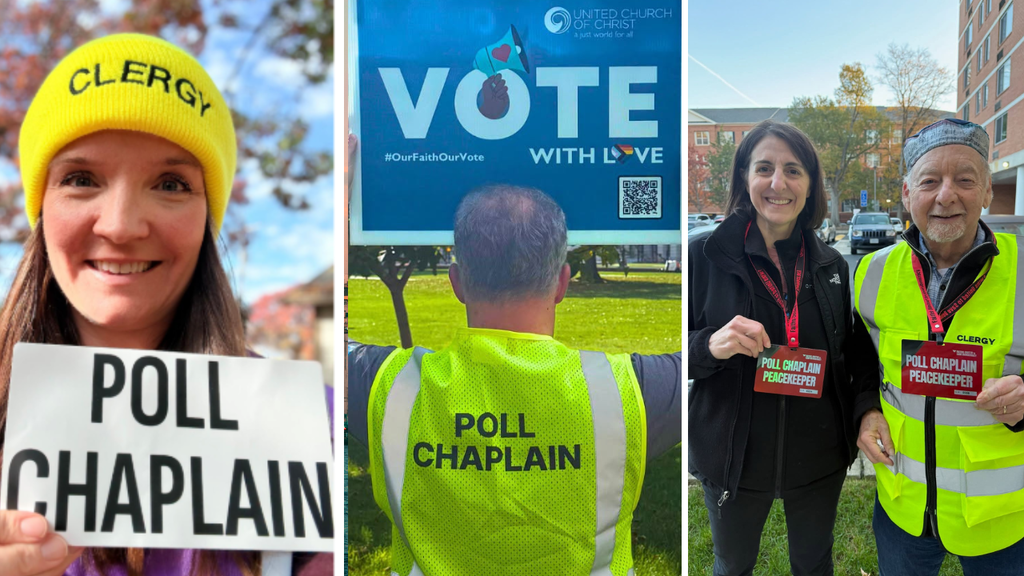
Peace at the polls: UCC clergy and laity show up on Election Day, providing calm for the anxious and agitated
When the Rev. Allison Smith arrived at Lewiston, Maine’s polls for early voting, it wasn’t...
Read More
Faith, Visibility, and Justice: UCC Joins National Trans Visibility March in Puerto Rico
The following is a roundup of the National Trans Visibility March and Gathering that was held...
Read More