General Synod celebrates land return to Dakota Association
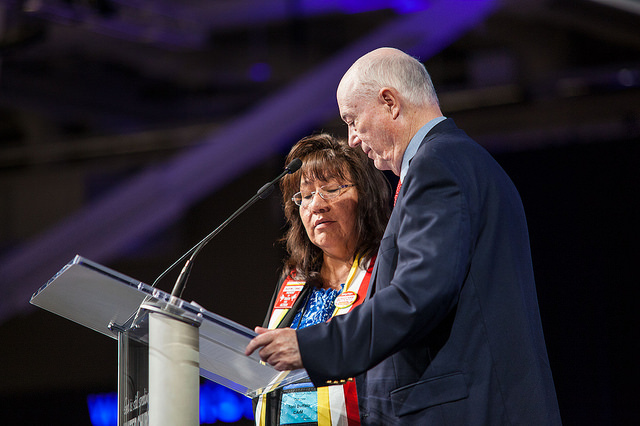
 In a moment to highlight faithfulness, trust and an emerging partnership, General Synod 2015 paused from deliberating business to celebrate the land transfer of more than 20 parcels of tribal land from the South Dakota Conference of the United Church of Christ to the Dakota Association.
The recent land transfers were for church sites in Nebraska and North Dakota that are part of the Dakota Association.
“It really was a labor of love,” said the Rev. David Felton, interim conference minister of the South Dakota Conference.
In all, more than 20 deeds to Native American UCC church sites and adjacent lands were transferred to the association. The South Dakota Conference began transferring a majority of the deeds in 2012, and before that, three other parcels were returned to the Cheyenne River Sioux tribe in the 1960s.
The Rev. Geoffrey A. Black, UCC general minister and president, was present at the South Dakota Conference Annual Meeting in 2014 when the titles to church properties and adjacent lands in Nebraska and South Dakota were handed to the Dakota Association.
“The ceremony was quite moving. The process of transferring the land has taken years, and it was gratifying to witness the culmination of the process, with the last of more than a dozen deeds transferred by the South Dakota Conference,” Black said.
The church land deeds were held by the mission organizations of the denominations that preceded the UCC, and were transferred to the South Dakota Conference after the UCC was formed in 1957. The conference held those deeds for decades “in trust” on behalf of the Dakota Association. Only recently did the conference and association begin the process of transferring the lands.
Black also lauded the growing relationship between the conference and the association as “positive and constructive.”
“This will make it possible for the incoming conference minister, the Rev. Gordon Rankin, to begin his tenure in South Dakota with an opportunity to build an even stronger relationship with the Lakota — a relationship of mutuality, trust and equal partnership,” Black said. “A relationship free of the anger, frustration and both perceived and real paternalism and racism that have been impediments to right relationship in the past.”
Related News

Creation Justice: How people in Memphis have been taking action against hyper-scale data centers
When Alexis Humphreys began working on a grassroots effort to confront Elon Musk’s xAI data...
Read More
The good old church dinner gets reimagined as hunger and loneliness rise: Free meals are life-saving ministries
She was one of many who came forward to the communion table, taking with her two tiny cups...
Read More
National Ministries, along with Central Pacific Conference release joint statement condemning school shooting in Bend, Oregon
The United Church of Christ, in collaboration with the Central Pacific Conference, has...
Read More