Creation Justice: How people in Memphis have been taking action against hyper-scale data centers
When Alexis Humphreys began working on a grassroots effort to confront Elon Musk’s xAI data center in Memphis, Tennessee, she said it started with about 10 people.
Now it’s more than 300 people, she said.
Their story of fighting for environmental justice is the focus of a short documentary, “We Went to the Town Elon Musk is Poisoning” created by the nonprofit More Perfect Union. It’s a “powerful 17-minute video” that many Climate Hope Affiliate churches and chapters have been screening together, according to the Rev. Brooks Berndt, United Church of Christ Minister of Environmental Justice.
In a recent UCC Climate Justice webinar, Taking Action on Data Centers, Humphreys shared her story of how the people in her Boxtown neighborhood of southwest Memphis have been organizing and advocating for their rights to clean air and water.
‘More about money than people’
Humphreys can see the smoke from the gas turbines constantly running outside of the SpaceXAI hyper-scale data center from her front porch at night, she said.
The air constantly smells like gas, the water turns brown at times, and people in her community are newly plagued with headaches, respiratory illness, sinus infections, and other health conditions, she said.
Humphreys has begun having asthma attacks – something that hasn’t happened since she was a child, she said.
Though gas turbines have typically been reserved for emergency situations, data centers have been using them to bypass the wait for connection into the electrical grid. The turbines emit constant air pollution that includes fine particulate matter, which is widely recognized as harmful to human health.
But local officials in Memphis approved their use for SpaceXAI.
“I feel like we’re just a social experiment, like a scientist experiment – that’s what we’re getting treated like right now,” Humphreys said. “I don’t think they care. They care more about the money than the people.”
Boxtown is a neighborhood founded by formerly enslaved people – a community with deep historical ties to this land. The predominantly Black working-class neighborhood already hosts seventeen industrial facilities – a circumstance that aligns with U.S. patterns of placing toxic facilities in predominately Black and Hispanic communities.
“So we just continue to fight. We continue to do rallies. We continue to let them know what we don’t like and what answers we want, but we never get the answers we’re really looking for,” Humphreys said.
Following the community’s fierce opposition to these kinds of data centers, Memphis City Council is set to consider a moratorium on new data center activity.
‘God is seen through disruption’
This kind of community advocacy and holy disruption of injustice is where God can be found, reflected the Rev. Michael Malcom, executive director of Alabama Interfaith Power and Light and co-host of the Creation Justice webinars.
“I would argue we recognize God because God is disruptive,” he said. “Our Genesis narratives testify of a disruptive God who, out of the void, formed life and all that exists in its ecosystem. We even see Jesus being disruptive when Jesus disrupts the temple system of exploitation. The Holy Spirit was disruptive, and the Holy Spirit’s appearance on the day of Pentecost. God is seen in disruption. God was seen in Martin Luther’s disruption in the Protestant Reformation. God was seen in the Montgomery Bus Boycott. God was seen in the garbage workers strike in Memphis, Tennessee.
“God was seen through disruption then, and God is seen through disruption now.”
National advocacy on data centers
Two bills in Congress address the impact of data centers, Berndt shared.
“One thing that’s really noticeable for me and the more than a decade I’ve been working on these issues is just the way in which this has become a cross-partisan issue at the grassroots level of voters and constituents,” Berndt said. “It creates the rare opportunity for us to have bipartisan legislation.”
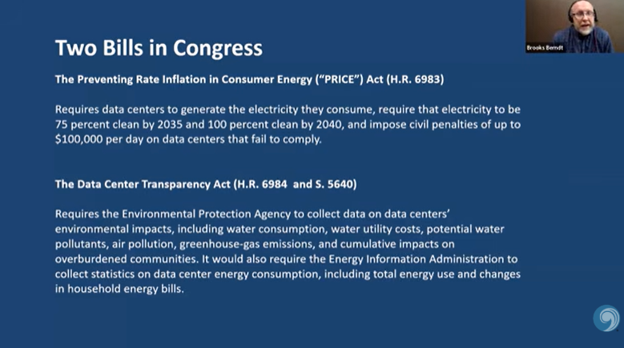
He encourages people to take advantage of this opportunity by writing Letters to the Editor to their local publications – like this one urging a stop to building data centers, written by a member of the Concord Chapter of the Climate Hope Affiliates.
Letters to the Editor alert members of Congress that the public is paying attention, they exert public influence, and they increase the likelihood that a member of Congress will become a co-sponsor on legislation, Berndt said.
Specific guidelines for writing a Letter to the Editor were provided in the Creation Justice webinar, beginning at the 39-minute mark.
View the full Taking Action on Data Centers webinar here.
Content on ucc.org is copyrighted by the National Setting of the United Church of Christ and may be only shared according to the guidelines outlined here.
Related News
Creation Justice: How people in Memphis have been taking action against hyper-scale data centers
When Alexis Humphreys began working on a grassroots effort to confront Elon Musk’s xAI data...
Read More
The good old church dinner gets reimagined as hunger and loneliness rise: Free meals are life-saving ministries
She was one of many who came forward to the communion table, taking with her two tiny cups...
Read More
National Ministries, along with Central Pacific Conference release joint statement condemning school shooting in Bend, Oregon
The United Church of Christ, in collaboration with the Central Pacific Conference, has...
Read More