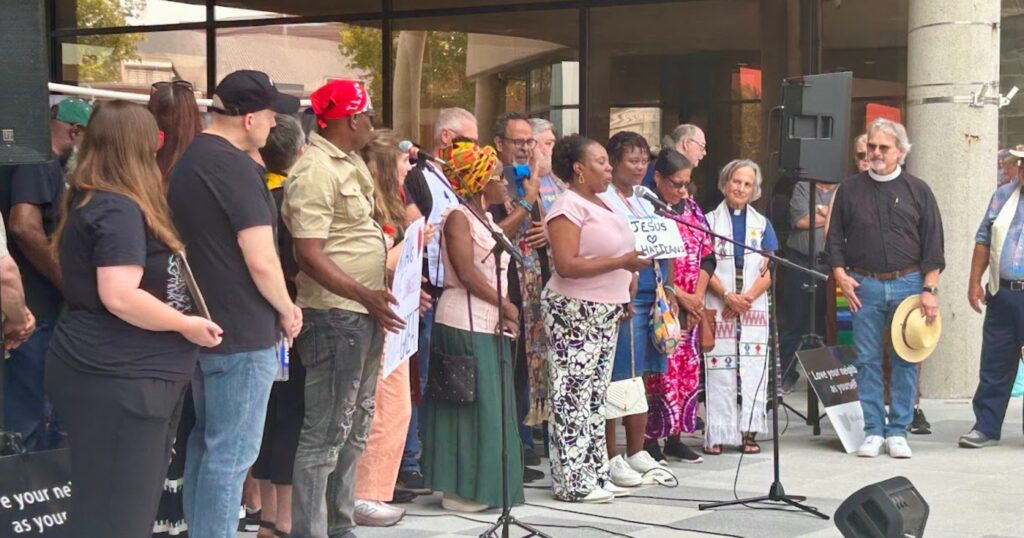
In Springfield, faith leaders from near and far joined rallying cry to ‘unshackle’ Haitian immigrants
In Springfield, Ohio, U.S. Immigration and Customs Enforcement have required many Haitian community members to wear ankle monitors. It’s one way that ICE has targeted Haitian immigrants in the city since the Supreme Court allowed for the Trump administration’s end to Temporary Protected Status for Haitians in recent weeks.
In response, faith leaders and others from across the country gathered in Springfield over four days, August 27-30, calling for authorities to “unshackle Springfield” and end the dehumanizing practices creating fear among the community.
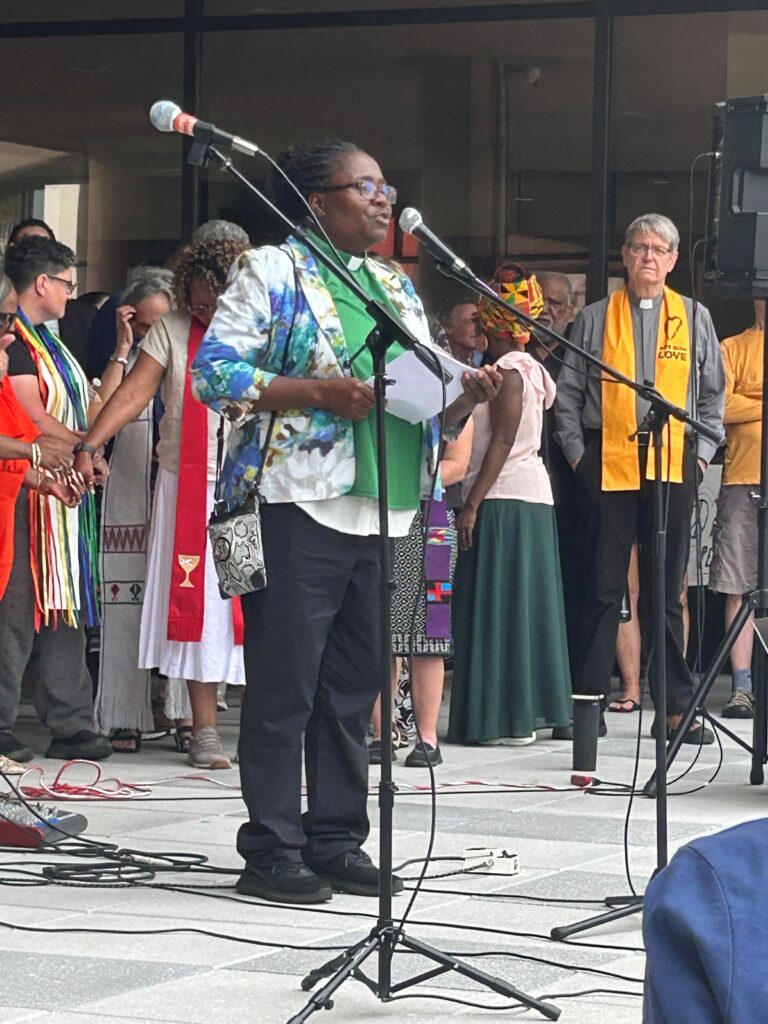
United Church of Christ Minister for Refugee and Migration Services, Megan Bergert, went to Springfield and heard local organizers emphasize the fear in every corner of the community.
Two local Haitian pastors were detained in recent weeks, one arrested by ICE while getting gas at local gas station.
“People are just disappearing and nobody knows where they are,” Bergert said. “Last month there were more arrests than there ever have been – it was a record for Trump’s second term, and you wouldn’t know that from coverage. I think they have intentionally started to do it more quietly.”
‘This is a human being issue’
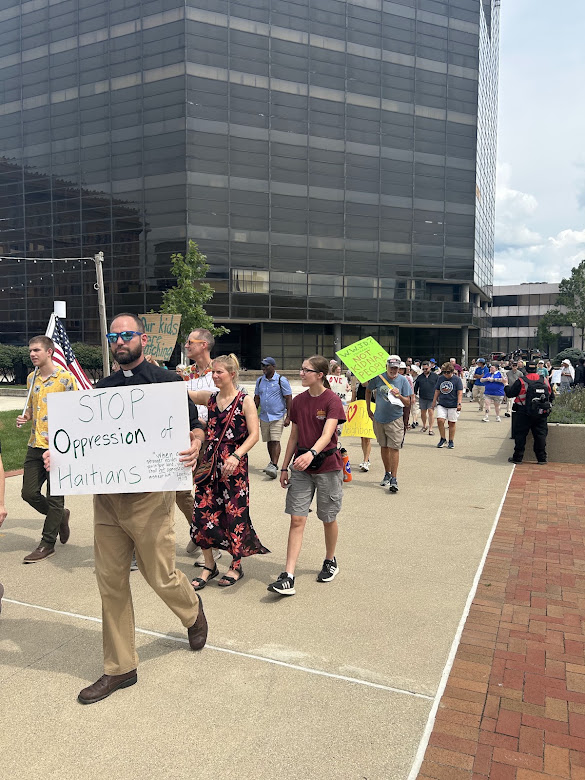
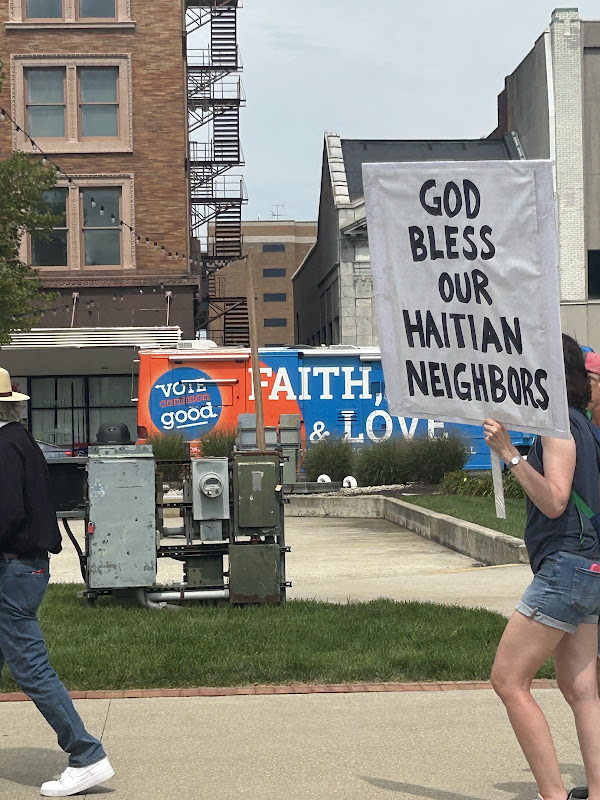
On Sunday, August 30, Bergert joined hundreds in a community potluck, rally, and Jericho walk, where local pastors invited those gathered to march around the public square seven times as a reference to the biblical walls of Jericho falling after the people marched. Those gathered carried signs affirming Haitian neighbors and singing, “No hate. No fear. Immigrants are welcome here.”
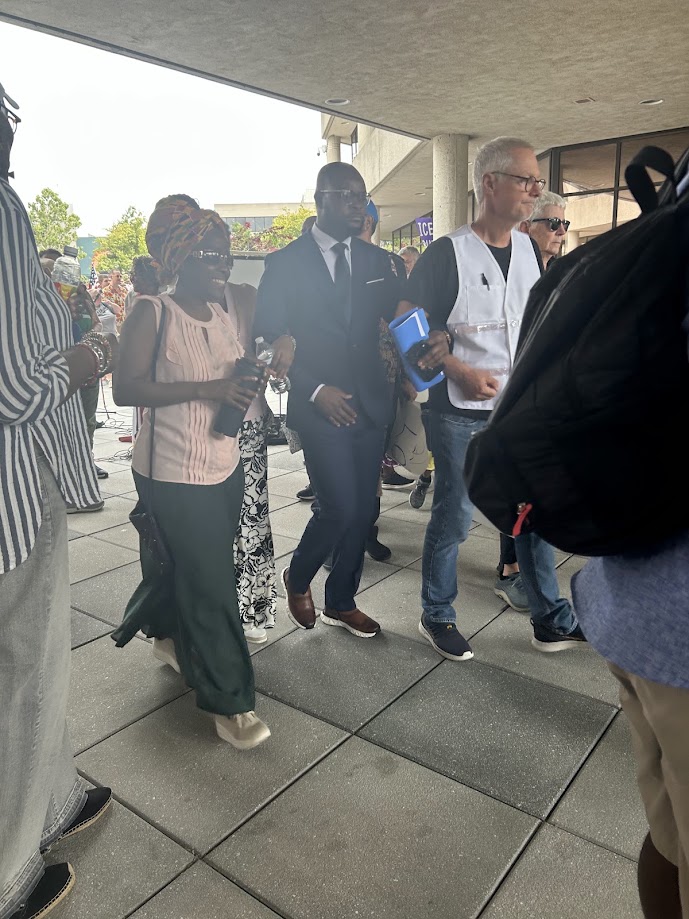
Viles Dorsainvil, executive director of the Haitian Support Center in Springfield, spoke to the crowd, emphasizing the human beings behind the statistics who are living in fear, afraid to leave their homes even for essential needs.
“Our community is suffering,” Dorsainvil said. “Imagine waking up every morning and wondering whether leaving your house could change your life forever. Imagine having children who need food, clothing, transportation, and a safe home, but being afraid to go outside to earn the money necessary to provide those basic necessities. This is not simply an immigration issue. This is a human being issue.”
‘To stand alongside’
For four days ahead of the rally, people were called to stand with local Haitian leaders by coming to Springfield for trainings, serving in volunteer assignments, and joining the public witness.
The Rev. David Long-Higgins, conference minister for the Heartland Conference UCC, attended and worked alongside others to connect people to Ohio Senators and urge them to sign on to a bill that would extend temporary protected status for the Haitian community. Other groups worked to assemble food boxes and provide pastoral and trauma care, he said.
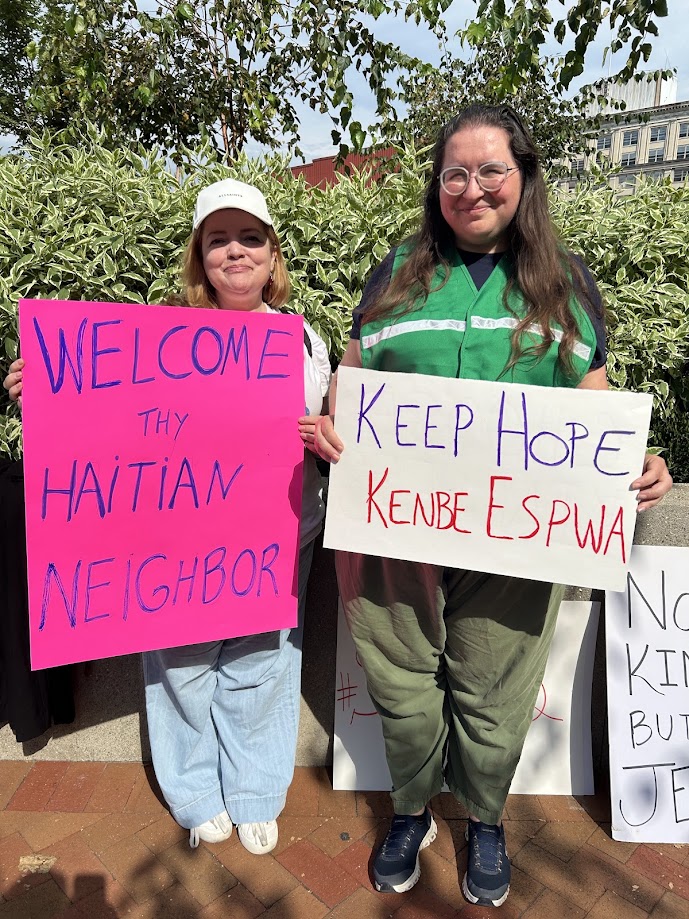
“One of the most important conversations I had during my time in Springfield was with a Haitian leader who emphasized how important it was that people showed up to stand alongside and advocate on behalf of a community clearly gripped by fear,” Long-Higgins said.
One impetus for local leaders inviting people of faith to come to Springfield was that, according to the organization Ignite Peace, people had witnessed ICE standing outside of church services in recent weeks.
In response, clergy and allies stood in front of two Haitian churches during worship on Sunday, August 30, to support and protect Haitians’ right to practice their faith.
One person who participated in this action described to Bergert that three people who were Haitian pulled up in a car to the clergy who were gathered, visibly shaking as they shared that a family member had been detained, and they needed assistance with food and rent, Bergert said. Some of the clergy were able to quickly connect with direct ways of resource-sharing, she added.
“One of the biggest things I heard from them was just the level of visible fear,” Bergert shared.
The weight of ‘shackles’
The focus to “unshackle Springfield” aims to reference ICE usage of ankle monitors as inhumane treatment of Haitian community members — treatment that faith leaders and advocates in Springfield have likened to shackles once placed on enslaved people in the United States.
In a press conference held by Springfield faith leaders on August 28, the Rev. Adam Banks, pastor of First Baptist Church of Springfield, emphasized this as racial injustice and the need to “call these practices what they are — technologically advanced ankle and wrist shackles that are still as heavy as they were for my ancestors.”
Banks noted Haiti’s history as the first free Black republic that advocated for the abolition of slavery and “demonstrated Black determination” – a history that, he said, calls for people to stand in solidarity with the Haitians currently “being targeted by systems of detention, deportation, surveillance, and electronic monitoring.”
The devastating impact of these ankle monitors has most recently come to light with the tragic death of Pierre Damas Bel, a 20-year-old student and athlete who had been forced to wear one. Bel died on August 31 walking into traffic, which his family has described as Bel taking his life in association with the shame, stigma, and fear he experienced wearing the monitor.
‘No one should live in fear’
It’s crucial to remember, Bergert emphasized, that through TPS, Haitians “received a very distinct invitation to come here, find safety, and make lives here, because where they come from is not a livable country right now.”
The conditions are so poor in Haiti that even the U.S. State Department acknowledges it with a continued “Do not travel” designation to the country – a dynamic named several times at the Unshackle Springfield event.
According to United Nations reports, gangs in Haiti continue to terrorize communities with “wanton, intentional infliction of incredible pain on people who often are just in the wrong place at the wrong time.” There have been over 600 deaths, nearly 400 injuries, high rates of sexual violence, and more than 18,000 people in Haiti forced to flee their homes during the 4.5-month period leading up to July 31 of this year.
“An explicit part of TPS is that as long as those conditions continue in Haiti, you’ll have a refuge here,” Bergert reflected, “But nothing has changed. No increased safety, security, economic conditions – nothing. All of this is a broken assurance, a total re-writing of what was set forth.”
“My time in Springfield only deepened my concern for the Haitian community and my anger at the arbitrary removal of protections that were put in place to offer relief from an untenable living situation in Haiti,” Long-Higgins said. “It is important to continue to show up and stand in solidarity with our Haitian siblings because Christ calls us to love our neighbors by working for the flourishing of all God’s people.
“It is vitally important for the Haitian community to know that there are followers of Christ and others who believe that no one should live in fear simply because of where they are from.”
The United Church of Christ offers ministries and resources that support mental, emotional, spiritual, and community well-being. If you or someone you know is feeling overwhelmed and in need of immediate support, you are welcome to call or text 988 to reach the Suicide and Crisis Lifeline.
Fore more resources and support from the United Church of Christ, please visit and bookmark these sites:
🔗 UCC Mental Health Ministries: Disabilities and Mental Health Justice – United Church of Christ
🔗UCC Harm Reduction & Overdose Prevention Ministries: Harm Reduction and Overdose Prevention Ministries – United Church of Christ
🔗 UCC Wellness Ministries: UCC Wellness Ministries – United Church of Christ
🔗 Mental Health Network Resources and Toolkits: Congregation / Synagogue / Organization Toolkits
🔗Global HOPE Emotional & Spiritual Care Team resources can be found at the bottom of this page: Emotional and Spiritual Care – United Church of Christ
Content on ucc.org is copyrighted by the National Setting of the United Church of Christ and may be only shared according to the guidelines outlined here.
Related News
A message from GMP Karen Georgia Thompson about Vote Faithfully Sunday
Ahead of next Tuesday's Midterm Elections, United Church of Christ General Minister and...
Read More
The Whole Truth
These days it is hard to decide what to believe. Misinformation, disinformation, and...
Read More
Fall Meeting Report of the UCC Board of Directors
This report comes from the Rev. Jasmine C. Quinerly, Chairperson of the United Church of Christ...
Read More