When agitators interrupted worship, two churches leaned into the power of song and community
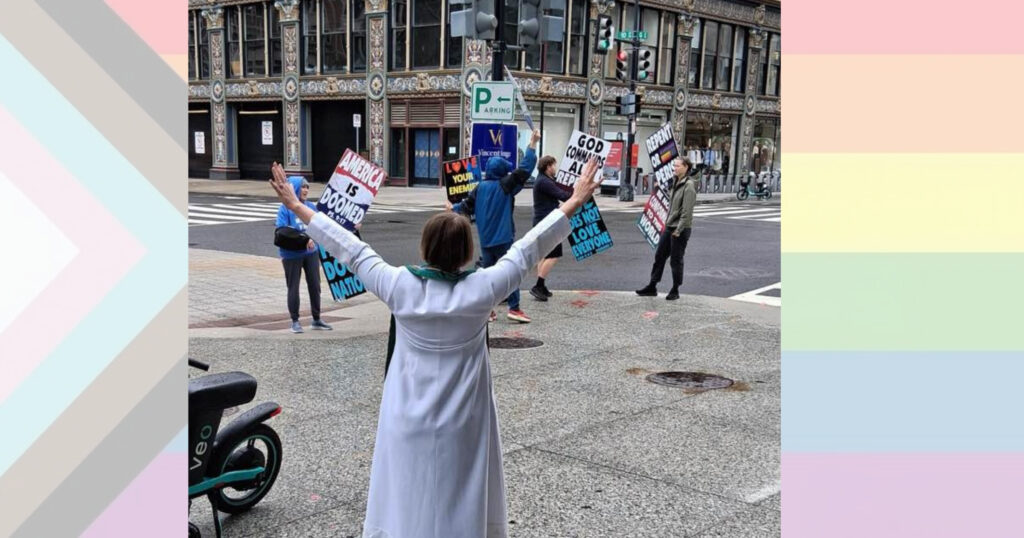
When a group from Westboro Baptist Church staged themselves with hateful signs and chants in front of First Congregational United Church of Christ in Washington, D.C., on a Sunday morning, May 24, the earliest arrivers to church strategized quickly about how to respond.
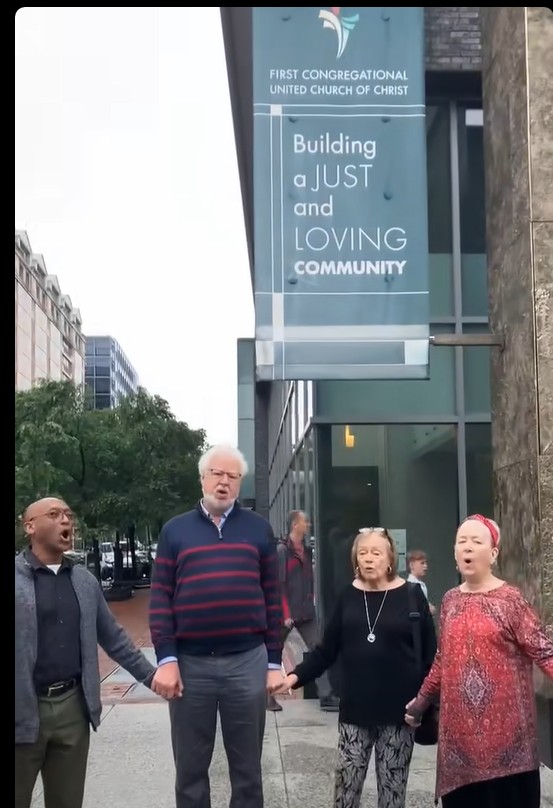
The Westboro group refused requests to move, and after calls to the police, First Church leaders learned that the group had a permit to stand at that corner. The church choir was warming up in the sanctuary, and they, together with others, felt moved to form a semi-circle around the protestors and sing love through music.
“We formed a half-circle, facing the agitators, linked hands, and sang ‘We Shall Overcome,’ a song that has had a meaningful history in our congregation since Freedom Summer. The song led to spontaneous testimonies about the deep, abiding love of our God for all people, no exceptions,” reflected the Rev. Amanda Hendler-Voss, First Church’s senior minister.
Social network of prayer
Hendler-Voss quickly shared a short clip of the singing on social media with requests for prayer, and it was viewed more than 25,000 times, she said.
“Because it was posted before worship on Sunday, UCC congregations around the nation lifted us up in prayer that morning,” Hendler-Voss said. “This is what it feels like to belong to one another and to know that we will defend each one’s dignity together, buoyed by a theology that unequivocally affirms that God is love.”
The Westboro group left shortly afterwards to stand outside of other sanctuaries that morning, Hendler-Voss said, but only after chanting slurs at congregants entering the building.
Following the event, Hendler-Voss sent congregants a pastoral letter affirming the belovedness of all people, reflecting on how such an instance impacts people differently and that “all your feelings are valid and worthy of being welcomed into the presence of God’s unflinching, unfailing, always-with-us, ever-abiding, fierce love.” She invited them to a space of dialogue and care during the following Sunday’s church service, rearranging what had been previously planned.
Agitators in worship
Churches who visibly and publicly seek to embody God’s inclusive love in some communities have faced instances of defaced banners and flags and threats. But recently, First Church and Faith United Church of Christ in New Braunfels, Texas, have had experiences of verbal agitators arriving before and during worship to offer the violence of hateful words face-to-face.
At First Church, Westboro Baptist protesters have showed up before. In 2013, the church hosted the Ford’s Theater production of the Laramie Project, which welcomed the father of Matthew Shepherd. When the theater learned Westboro planned to protest, people wearing angel wings and members of First Church surrounded the building to block visibility of the Westboro agitators.
Creative, non-violent tactics like this offer ways to “continue to proclaim that God is love, using the power of song, unity, scriptures, and perhaps even side-walk chalk, to counter hatred with the unbreakable truth of our God-given human dignity,” Hendler-Voss said.
Song to drown out hate
In Texas, Faith UCC is no stranger to agitators targeting their congregation as an LGBTQ+ inclusive community northeast of San Antonio.
The church received significant national attention when Pink News shared a video of Valentina Gomez, a far-right social media influencer, spouting messages of hate and condemnation in the church’s sanctuary during worship in November 2025.
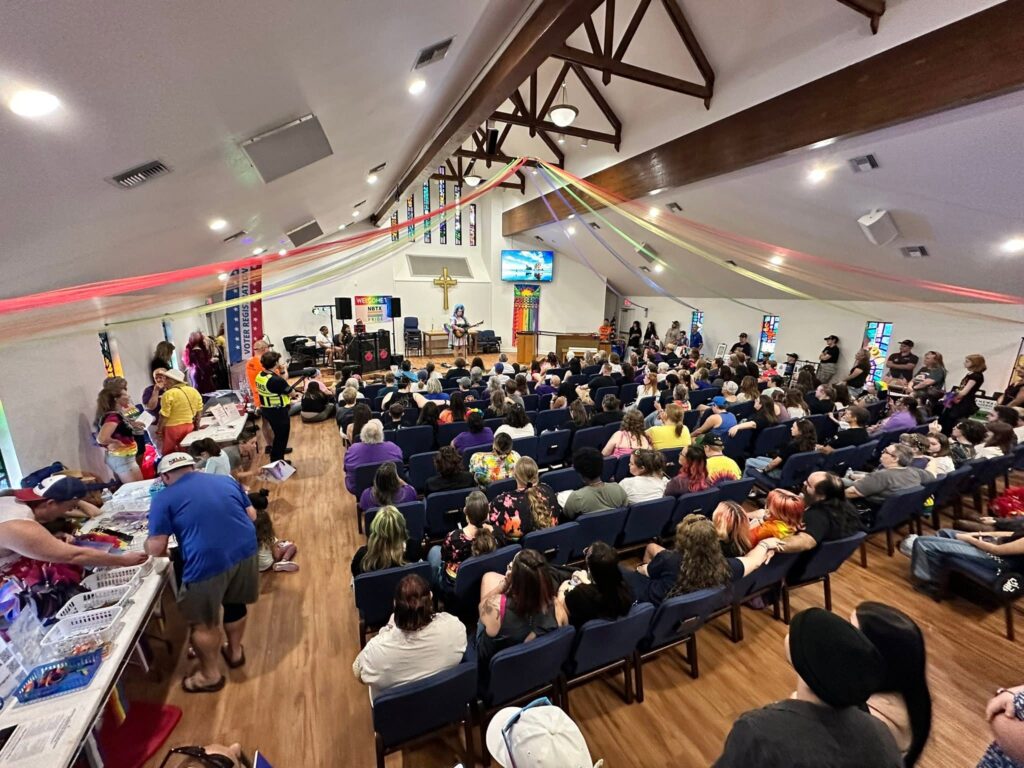
The congregation immediately began singing the song “They’ll Know We are Christians by Our Love” while a designated leader called the police, and several people from the congregation moved towards Gomez, gesturing for her to move toward the building’s exit.
“We sang so loudly and so beautifully that a woman and her queer child that were visiting, sitting right in front of Valentina, could not hear or understand what she was saying,” said the Rev. Carla Cheatham, pastor of Faith UCC.
Creating a safety plan
The people at Faith UCC had put plans in place for a moment like this, as just a few weeks before this, an unfamiliar young man came into worship wearing a hat low over his face.
Wanting to ensure safety, Cheatham improvised and introduced the “Passing of the Peace” earlier than normal in the service so she could meet the man. It wasn’t until later in the service that the man stood up and began yelling judgmental words about gay people.
People were scared, Cheatham said. A leader called the police, who were slow to come, and others encouraged the agitator to leave, which he soon did.
There had already been a potluck planned for after the service, and so church leaders used this time to pray and debrief what had happened, and they began to put a more comprehensive safety plan into place.
Cheatham told congregants that on any occasion like this, if a church leader begins to sing a cappella loudly, everyone should join in singing “They’ll Know We Are Christians By Our Love” and start moving together.
“We will sing so loudly that nobody will be able to hear them,” Cheatham said. She regretted not having this plan in place before the first agitator interrupted worship, she added: “I wish we had let love be louder instead of trying to shut him up.”
This conversation and safety plan prepared them to react with “loud love” when Gomez arrived in worship just weeks later.
It’s still scary, Cheatham said, and some people, particularly families with children – have stop attending the church because of fear of these instances. Being an inclusive church often targeted by political actors can be treacherous for many reasons, she said, including logistical ones.
“We take hits financially and membership-wide when people get scared,” Cheatham said.
Building community ‘outside the walls’
One piece of advice Cheatham offers is to “gather your church outside the walls.”
In the weeks following these instances of agitation, she put out an invitation locally for people of any faith to act as allies by sitting in the back row of their sanctuary during worship “to assure members that they don’t need to feel alone.”
“They filled the back three rows of the sanctuary the next week,” Cheatham said. And she invited the church to adapt the words of the song “They’ll Know We Are Christians by Our Love” to “They’ll Know We’re God’s Children by Our Love” to include those who showed up who were not Christian.
“We’ve spent years building that kind of solidarity in this small town, and it’s paying up more and more,” Cheatham said.

Resources for congregational safety and agitator response
✅ The UCC’s Nurture the Soul has recorded several webinars addressing congregational safety with resources and experience-sharing. These include:
- A Building Congregational Community Safety webinar, exploring the “ecology of community safety.”
- A three-part series on Security and Faith: Imagining Community Safety for All; Abolitionist Perspectives; and Threats and Responses from UCC Local Churches.
✅ Organizations like Parasol Patrol have practices and resources for gathering people to hold bright rainbow umbrellas that creatively shield children and young people from the presence of hate groups.
✅ Hendler-Voss emphasized the value of having pastoral staff and others in the congregation trained in de-escalation tactics.
✅ Ideas shared by Hendler-Voss and Cheatham for potential non-violent responses to an agitator that lead with love and compassion, include:
- Developing a safety plan of who will do what and when before it’s needed, and sharing with the congregation;
- Building relationships with the community beyond the church walls who can be invited to come and stand in solidarity;
- In the case of an agitator present, using immediate group singing to drown out voices of hate, with a song selected in advance that everyone knows;
- Creating visual blockage of hateful signs through umbrellas, signs or banners, or something like the angels wings used by the Laramie Project;
- Employing a list of love-based scriptures read through a bullhorn to drown out hateful messages outdoors;
- Using sidewalk chalk to write and draw messages of love around the agitators, which Hendler-Voss heard was done at a past UCC General Synod;
- “Flocking” to move someone out of a space by having a group of de-escalation leaders form a semi-circle around the individual and slowly advance, while either singing or repeating gently, “You need to leave this space,” so that the person backs their way out of the room or leaves;
- Forming safety lines from the sidewalk to the door to allow people to enter the church safely while blocking them from the agitators;
- Theological grounding through preaching and teaching;
- Pastoral care and processing opportunities afterwards.
‘Love gets louder’
A value to hold at the center, emphasized Cheatham, is to let love be louder.
“We won’t be baited into returning hate for hate. Jesus didn’t, and we believe God works to transform chaos and that which is intended for harm into love and peace and true community where all are seen as worthy, beloved, divine, and enough,” Cheatham said. “So when they scream, LOVE GETS LOUDER, leaving no room for hate.”
Content on ucc.org is copyrighted by the National Setting of the United Church of Christ and may be only shared according to the guidelines outlined here.
Related News
National Ministries, along with Central Pacific Conference release joint statement condemning school shooting in Bend, Oregon
The United Church of Christ, in collaboration with the Central Pacific Conference, has...
Read More
‘No death should be fodder for public entertainment’ – Rev. Karen Georgia Thompson issues statement on the initial intention of the live broadcast of the execution of Nidal Malik Hasan
The United Church of Christ’s General Minister and President/CEO, the Rev. Karen Georgia...
Read More
We Are Not Alone
A Tent of Our own Making is a series of gatherings in the United Church of Christ where...
Read More