New toolkit on psychedelic medicines in the UCC offers resources, invites conversation
The Rev. Molly Baskette recalls a conversation with a mother who shared that her young adult child’s life was saved by treatment with a psychedelic medicine. The mother reflected that talking with Baskette about this made her feel “so much less alone.”
“I was stunned because her child was seeking treatment for a mental health condition with a legal substance, and she still felt like she had to keep it a secret – that she would be stigmatized if it came out,” Baskette said. “She wept and I wept too, mom to mom.”
“To me, that was everything,” Baskette reflected, that people can feel less alone and have the possibility of finding medicines that might ease suffering, offer a breakthrough, heal trauma, or keep them alive.
This kind of connection and openness is at the heart of the work of a grassroots Entheogens in the United Church of Christ Working Group, which has been aiming to widen conversations about psychedelic medicines within the denomination. An entheogen is a “psychoactive compound, typically from natural sources such as plants or fungi, that can alter consciousness and evoke spiritual and mystical experiences.”
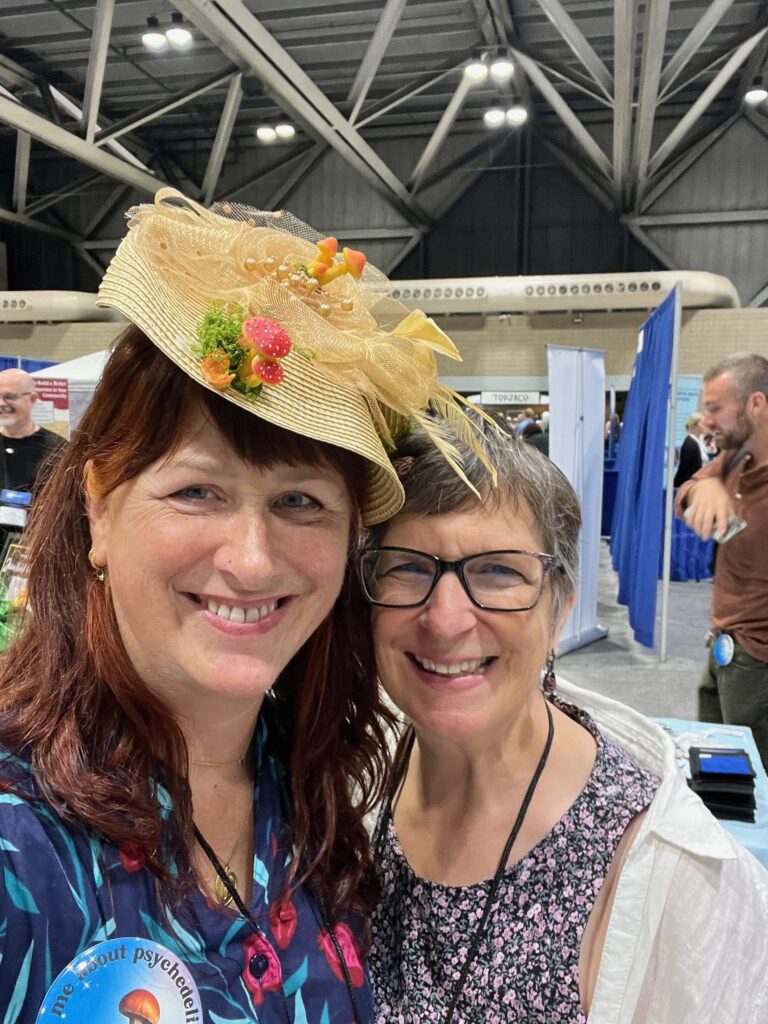
Baskette, who is part of the Working Group Strategy Team, is a longtime UCC pastor and recently began a new position as a trained psychedelic-assisted spiritual care provider.
‘The church needs to have a voice’
There’s been a buzz around psychedelic medicines in the UCC in recent years. The Central Pacific Conference UCC passed a resolution in September 2025 calling for ecumenical engagement and faithful support for decriminalizing entheogenic and psychedelic medicines.
Broader attention to psychedelics has soared in recent years, with studies examining their ability to treat a variety of mental health conditions, such as severe depression, OCD, PTSD, and end-of-life anxiety. An Executive Order issued in April 2026 gave directions to fast-track legal access to some psychedelic medicines for mental health treatment.
“The church needs to have a voice in this unfolding nexus of mental health, spirituality, criminalization/decriminalization, for-profit health systems, indigenous rights, therapeutic ethics, recreational use, and more,” the Working Group wrote in response.
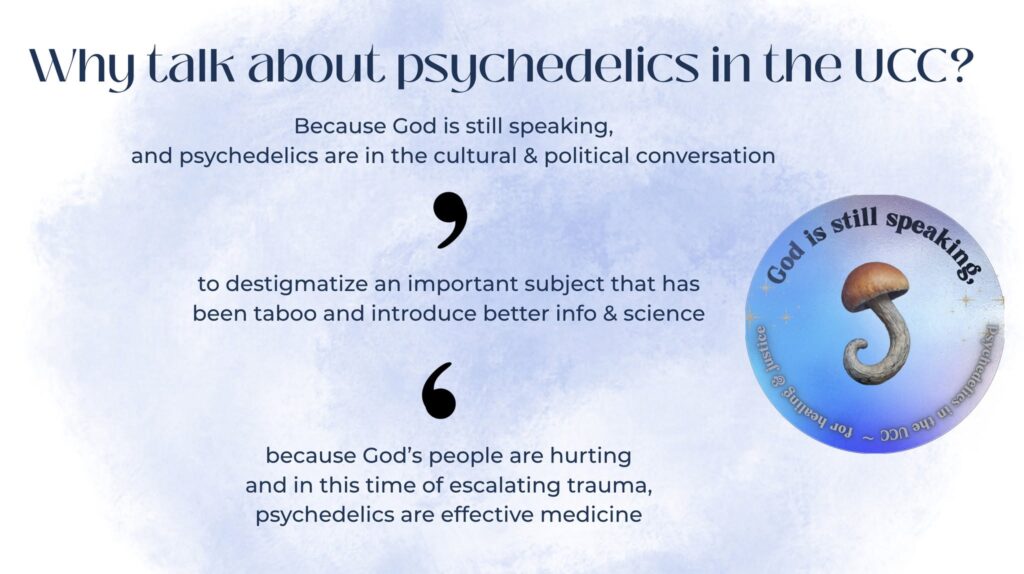
“More people are doing psychedelic drugs right now than in the history of the world – legally in places where it’s legal, or ketamine, for example, is psychedelic-adjacent and legal in all 50 states, but also underground or illegally, both recreationally and therapeutically,” Baskette said. “If that many people are doing them already, let’s have a conversation. What place does this have in the church? Let’s understand what’s true and what’s not true. Let’s get it all out into the daylight.”
Psychedelic medicines and the church
Now, the Entheogens in the UCC Working Group has released a new resource with the widespread invitation for people throughout the UCC to engage in thoughtful spiritual and theological inquiry and “consider how God might be speaking through these new/old medicines.”
This resource, Psychedelic Medicine in the UCC Teaching Toolkit, is designed to offer context and tools for beginning or continuing conversations in their communities about this work.
The Working Group aimed to officially bring a resolution to General Synod 35 in 2025, though it didn’t happen due to missing a procedural step. The group has met with the Resolution Committee to ensure the proposed resolution, which focuses on work toward the decriminalization and legalization of entheogenic substances, will come before the next General Synod in 2028.
In the meantime, the toolkit offers opportunities for continuing education and engagement, Baskette said.
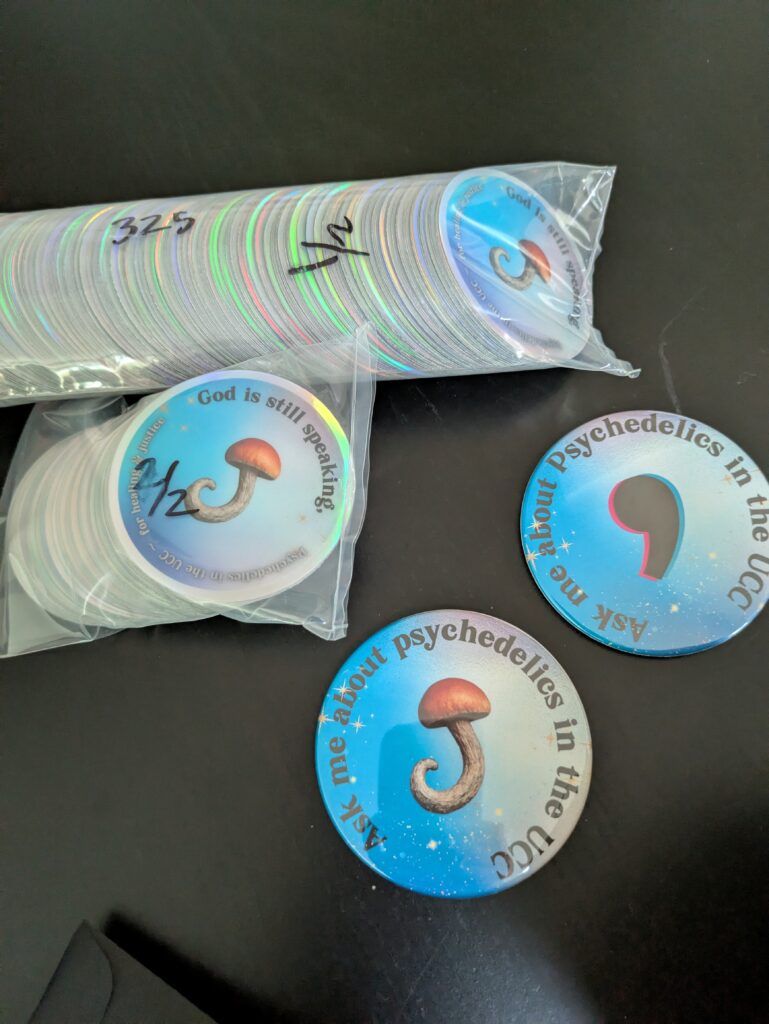
And the Working Group still carried the conversation to the General Synod 35 Exhibit Hall where Baskette, joined by the Rev. Molli Mitchell and others, donned mushroom fascinator hats and kaftans and offered resources and stickers with the UCC’s well-known “God is still speaking” phrase circling a small mushroom.
A path into psychedelic chaplaincy
Mitchell, who is pastor of Waverly Heights UCC in Portland, Oregon, also works as a licensed psilocybin facilitator in Oregon, one of just two states with legal psilocybin sessions. She is the first UCC clergy to be a licensed facilitator.
Mitchell’s pathway into psychedelic chaplaincy began after a cancer diagnosis in her 30’s. As she went through treatments and realized she would survive cancer, she found a pull to pursue divinity school and engage her interest and curiosity around practices of institutional repentance, healing, and repair.
Before beginning divinity school, Mitchell invited some good friends, one who is a therapist and one a psychologist, to help her create a sending ritual of camping in the desert with a psychedelic journey. It was transformative for her.
“It was a watershed moment for me. I carried and let go of a lot of grief in that journey,” she said.
In seminary, Mitchell encountered work around psychedelic chaplaincy and decriminalization, which resonated with her questions around institutional repentance practices.
“There are so many ways that psychedelic chaplaincy felt aligned with my background, interests, skill-sets, and what my community needs right now – what the church needs right now,” Mitchell said.
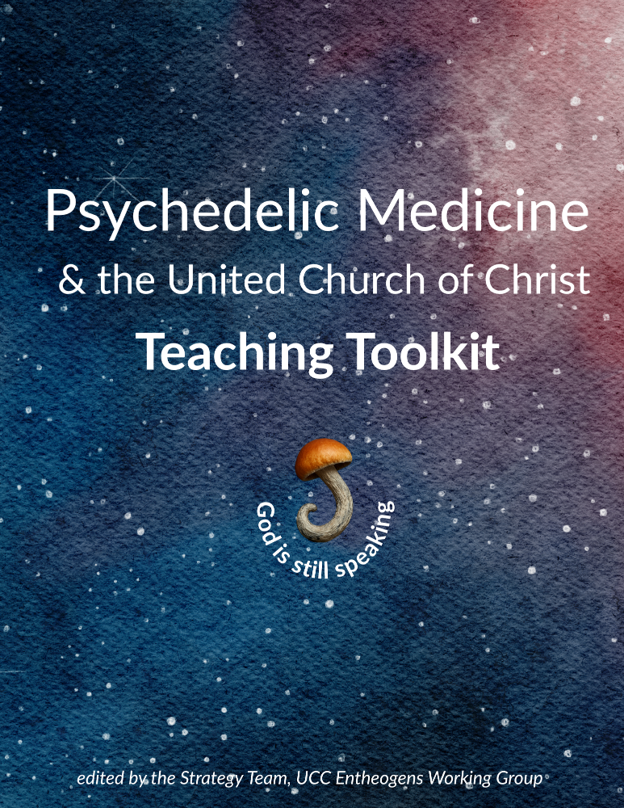
As psychedelic chaplaincy remains an emerging field, one resource in the Psychedelic Medicine and the UCC Teaching Toolkit includes a White Paper on The Case for Supporting Entheogenic and Psychedelic-Assisted Spiritual Care in the UCC, a resource designed for Committees on Ministry and chaplains in hospital or mental health settings in support of “people like me who believe this is part of my calling,” Mitchell said.
Decriminalization as spiritual work
The toolkit, as well as the proposed General Synod resolution, draw specific attention to the decriminalization of psychedelic medicines.
“Access is a form of justice,” Baskette said. “The war on drugs has disproportionately impacted people of color and poor people. The way Indigenous communities have been sidelined, or vilified, or criminalized for using these as sacraments in their religion and spirituality – that’s a whole other part of this conversation that the work of education, decriminalization, legalization, and building ethical structures for this address.”
This is important to grapple with from within a Christian context, Mitchell offered.
“One way that I would look at this is through the words of the UCC itself: God is still speaking,” she said. “Is this one way that God is still speaking to us? That God is making themselves known among us? I definitely think so. I know that several of my colleagues also think so. And if so, it behooves us to understand how we might access ways that God might be making themselves known in this moment, in this time. It’s also on us as folks with lineages of Christianity and carceral logic. How might we have participated in the criminalization of medicines that, for millennia, were used in sacred rituals? Medicines that our ancestors in the Christian church then demonized, marginalized, and took away the sacred use of for so many peoples all around the country and the world?
“It matters that we have a conversation about the impact of criminalization. And what decriminalizing some of these medicines might actually look like. I think that’s on us. I think that is our work to do.”
‘Being first makes a way’
The toolkit’s resources includes a list of “ambassadors” who are willing to speak directly with local churches or conferences via Zoom to “educate/destigmatize/inspire.” There are also slides designed for use in leading an adult learning hour.
“If you’re reading this, and the Holy Spirit nudges you and won’t leave you alone – even if this feels way out of your lane – consider just planning an hour after church and say ‘Hey, this is in the cultural conversation, so let’s talk about this.’ Use my slides, and most importantly, have a sweet conversation, friend to friend, sibling to sibling in your church about this because it’s important,” Baskette said, “And it could change everything.”
As the proposed resolution is planned for General Synod 36, Baskette described the opportunity it presents for the UCC to continue its legacy of “firsts” among Christian denominations around issues of justice and inclusion.
“Being first makes a way for there to be more,” she said.
Content on ucc.org is copyrighted by the National Setting of the United Church of Christ and may be only shared according to the guidelines outlined here.
Related News

We Are Not Alone
A Tent of Our own Making is a series of gatherings in the United Church of Christ where...
Read More
Reporter’s Roundtable: Citizens Bank, Antoinette Brown, Church and buildings, and Club West
UCC News recorded a special, live edition of the Reporter’s Roundtable featuring some of the...
Read More
As Chicago Theological Seminary ends 170 years of educating ministry leaders, talks to affiliate with Yale Divinity School get underway
Chicago Theological Seminary (CTS) and Yale Divinity School (YDS) have announced a proposed...
Read More