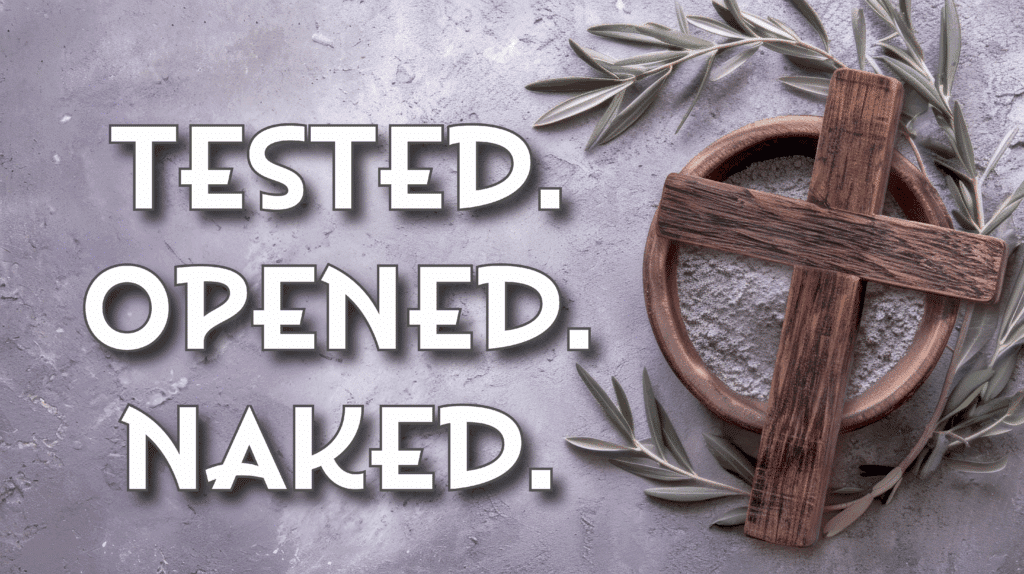
2026 Lent and Holy Week Series: Tested, Opened, Naked
Year A 2025-2026 Seeds and Ways Focus and Roadmap: Stay Awake
Keep awake, therefore, for you do not know on what day your Lord is coming.
(Matthew 24:42 NRSVue)
The liturgical calendar calls us to remember expectation. While our memories of the days preceding Christmas may include anticipating gifts and festival gathering around meals and decorated trees, that is not the memory Advent amplifies. While Epiphany greets us at the dawn of a new year, memories of midnight toast and kisses does not frame that season. Lent may evoke shudders as we consider how difficult it may have been to forgo that favorite practice, menu item, or other thing in order to share in the sacrificial activity of Christ. Yet, if that struggle fails to generate empathy for the suffering of our neighbor on our block and across the world, the sacrifice was empty. A sunrise service on Easter Sunday morning may transport our imagination to the empty tomb, but that shocking moment led to uncertainty, discovery, and an empowered movement that launched on the Day of Pentecost and continues today.
The future of the church faces threats. While some have the reasonable fear of closing church doors, the more urgent and salient problem is the church that has lost its way, its voice, its witness, and its commitment to embodying good news in the world as Christ’s agents in the world.
The call to remember expectation is a call to hope, to agency, and to activation in a world in need of conduits and co-creators of good news. In the anchoring text for the liturgical year, Jesus cautioned and encouraged their followers to “keep awake.” The command encompasses attentiveness, alertness, and readiness. The context of the passage emphasizes the anticipated return of Christ, the Chosen One. Could the Body of Christ reclaim its mantle and mandate to embody God’s love and liberating power in the world? Could that be the return we expect…to the movement to follow the way of Jesus in spirit and in truth…not to give us an escape to heaven but to realize the kindom on earth through our collective, Spirit-led salvific acts in the name of Jesus? Are we prepared and willing to be that church?
That is the question we will ponder in Year A even as we heed the call to “Stay Awake.”
2026 Lent and Holy Week Series: Tested, Opened, Naked
“Then the eyes of both were opened, and they knew that they were naked, and they sewed fig leaves together and made loincloths for themselves.” – Genesis 3:7
“Then Jesus was led up by the Spirit into the wilderness to be tested by the devil.” — Matthew 4:1
Lent reserves time for reflection, remembrance, and repentance. The lectionary reading from Genesis 3 revisits one of the origin stories. Following the magnificent and transcendent creative acts of the Holy One in Genesis 1 and the earthy creative acts of God who Companions in Genesis 2, the text explores the origins of human brokenness in relationship with the divine, the humane, and the remainder of the created order. That story cautions that there are competing forces at work in the Creator’s world that rely upon deception, manipulation, and human arrogance. That story reveals how denial, conflict avoidance, and projection compound the brokenness. That story invites us to examine the realities of being tested, the challenges that arise from opened understanding, and the response to recognizing our own nakedness (vulnerability and transparency) before God and one another.
During Lent, communities and individuals may adopt a fast, spiritual practice, ministry outreach, or faith formation study. Some may observe the season without breaks or follow the model of the early church and celebrate the Resurrection every Sunday despite the season. Whether your worship lays aside the “alleluia” or proclaims “hallelujah anyhow,” Lenten worship calls us to explore the liberating, redeeming, and sacrificial acts of Christ and to fortify ourselves to pick up our cross at the given time for the salvation, reconciliation, and restoration of the world that Jesus loves and exhorts us to do the same.
Scripture and Themes
Ash Wednesday A – February 18: Isaiah 58:1-12 | “Break Forth”
Lent 1A – February 22: Matthew 4:1-11 | “Led by the Spirit…Backed by the Word”
Lent 2A – March 1: John 3:1-17 | “Of Water and Spirit”
Lent 3A – March 8: John 4:5-42 | “Ripe for Harvesting”
Lent 4A – March 15: John 9:1-41 | “The Signs”
Lent 5A – March 22: John 11:1-45 | “Unbind”
Palm/Passion Sunday- March 29: Matthew 21:1-11 | “Cut Branches”
Maundy Thursday A – April 2: John 13:1-17, 31b-35 | “An Example”
Good Friday A – April 3: Good Friday A – April 3: John 18:1-19:42 | “No King But Caesar”
A Statement on the Lectionary Readings for Holy Week and Easter (from the Consultation on Common Texts)
This statement on the lectionary readings for Holy Week and Easter may be spoken in worship and/or printed/projected in service materials.
“Throughout Christian history, references to “the Jews” in scripture—particularly in John and Acts—have been used to perpetuate negative stereotypes and falsely assign blame for the death of Jesus. These references gloss over significant distinctions among religious leaders, such as Pharisees, scribes, and Sadducees, and obscure the fact that Jesus and his disciples were themselves Jews. As Christians, we confess and lament the history of anti-Judaism associated with these texts. We renounce the evils of violence and discrimination against Jewish people. We strive for mutual understanding, respect, and partnership with Jewish neighbors and commit ourselves to the work of reconciliation among people of all faiths. “
“No act of virtue can be great if it is not followed by advantage for others. So, no matter how much time you spend fasting, no matter how much you sleep on a hard floor and eat ashes and sigh continually, if you do no good to others, you do nothing great.”
― John Chrysostom
Graphics that you have permission to use in worship:

The Rev. Dr. Cheryl A. Lindsay, Minister for Worship and Theology, United Church of Christ, (lindsayc@ucc.org), also serves as a local church pastor and worship scholar-practitioner with a particular interest in the proclamation of the word in gathered communities.