‘A time to form unlikely allies’: Experts urge response to AI Data Centers in Creation Justice webinar
As massive data centers are being built or proposed across the country to accompany the rising use of AI programs, the burden of running these facilities is creating an impact on the surrounding people and land.
The director of the Michigan-based Flint Rising coalition Nayyirah Shariff points to studies estimating that in 2023, existing U.S. data centers consumed 17 billion gallons of water for the cooling systems – figures projected to double or quadruple by 2028. The centers also consume around 211 billion gallons of water indirectly through the electricity that powers them.
This is drinking water and electricity that will be diverted from communities that need these, Shariff said, with ordinary people being forced to pay increased utility prices all while facing the threat of water shortages.
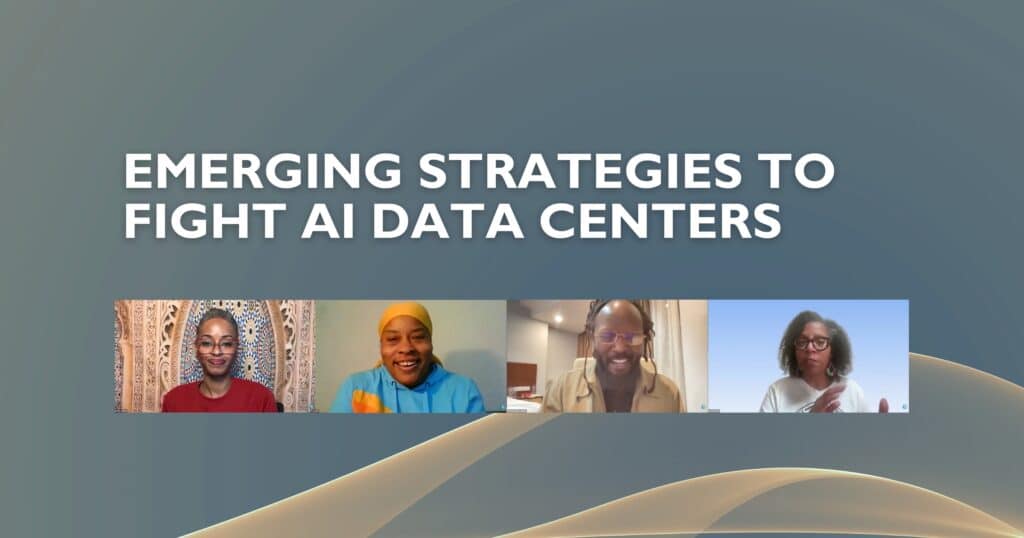
Shariff was among four experts on environmental justice and community organizing at a UCC Creation Justice webinar on Sept. 10 to address the pressing and interconnected environmental, extractive, racial justice, and economic justice concerns related to the expansion of data centers.
One of the most frightening aspects is the speed with which decisions are being made around data centers, Shariff said, with a lack of transparency that prioritizes profits and passing legislation without regard to the needs of ordinary people.
Lindsay Harper, national coordinator for Arm in Arm, emphasized the lack of precedent for how quickly data centers are popping up and policy changes are happening to support them.
“The amount of land and water going to companies instead of people is double digits,” Harper said. “We really have to be conscious about the philosophy behind land and water use, especially if we’re putting not just profits over people, but machines over people. That’s a scary thing to think about.”
Building collective mortality on data centers
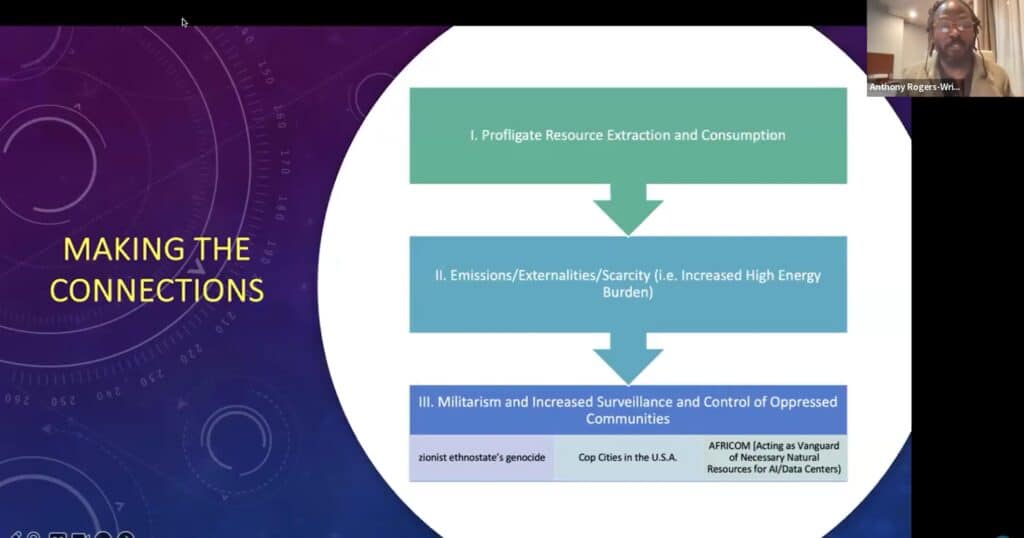
There is specific value and need for the United Church of Christ to take a deep dive into these issues, according to Anthony Rogers-Write, policy fellow at The Black Hive of Movement for Black Lives, given the UCC’s history of producing the groundbreaking Toxic Wastes and Race in United States report in 1987. The massive extraction and consumption around data centers create increased emissions, health impacts, and cost burdens with disproportionate impacts on Black, brown, Indigenous, and poor folks, he said.
Another significant issue is that data center projects are not federally mandated and so not subject to the National Environmental Policy Act, which makes it come down to environmental policies of each state, said Rogers-Wright.
“As we like to say in Nebraska, we don’t have any,” he added.
“We’re being sacrificed for industry once again,” Shariff said. “We’re being sacrificed for corporations; we’re being sacrificed for venture capitalists because they just want to be the one that’s on board for the next big thing.”
For all of these reasons, there is a need for a “collective maximum morality pitch” since AI is both a set of personal choices and decisions made by broader entities of nation states and corporations, Rogers-Wright said.
“AI and data centers represent the new Frankenstein of environmental racism and white supremacy efficiency,” he said. “AI works on large language models — large language models coming from a society where white supremacy is already ensconced — so AI is essentially allowing for the most efficient proliferation of white supremacy ideology, and that includes patriarchy, bigotry, all forms of oppression.”
There is great need for a person-centered human rights initiative, he said, as opposed to the common approach to center profits.
“The climate crisis, first and foremost, is a human rights issue. The emissions and all that other stuff are symptoms of the larger disease of white supremacy ideology, patriarchy, and colonization. And that’s the silver lining of AI and data centers: it elucidates the root causes of the climate crisis in ways that are simply irrefutable,” he said.
Actions for data center accountability
How, then, are people to respond to the problems caused by data centers?
Harper urges people to join the Minus AI campaign, where people commit to typing “-ai” into internet search engines as a way to opt out of using AI for searches.
“As it is, search engines automatically opt you in, and so the idea is we have to change that,” Harper said. “Ultimately, what we’re hoping for moving forward is policy that makes it so that you have to opt into AI versus having to opt out.”
Wanda Mosley, deputy policy director in Georgia at Black Voters Matter, emphasized the importance of old-school grassroots organizing at city councils.
Because data centers are so new, she said, they aren’t within city comprehensive plans and changes are likely to happen at city council meetings. The planning and zoning meetings, which happen first, offer more space for community members to express all of their questions and concerns.
“All of this info has to be synthesized and shared with your elected officials. What we found is they don’t know any of this stuff – and some who do know don’t care. The message has to be if you keep letting these types of things infiltrate our cities and be right next to our homes and schools, you won’t have a city to run in a few decades,” she said. “As the people who put them into office, it is incumbent upon us to bring the truth, let it live in light.”
Several counties are pressing to pass, or have already passed, moratoriums on all data center construction until a study can assess their impacts, Mosley said. A Data Center Organizing Toolkit is available.
“Now is the time to form allyships and coalitions with people who you may not think to form allyship with,” Rogers-Wright said. “Farmers and rural folk – they don’t want any of this stuff. I would also say homeowners who don’t want their prices to go up and not be able to turn on their water, and certainly our blessed Indigenous comrades – it’s their land, they don’t want to see anything worse happen to it. Remember, it was a coalition of a lot of people that eventually stopped the Keystone XL pipeline, and I think that we can bring back a renaissance of those coalitions. We’re going to need to do that for the larger climate fight too.”
Incumbent on people of faith
The Rev. Michael Malcolm, executive director of Alabama Interfaith Power and Light and co-host of the Creation Justice webinar series together with UCC Environmental Justice Minister Brooks Berndt, emphasized sharing this information in faith-based settings.
“You have an opportunity to use your voice to speak to your congregations so that your congregations can use their voice to speak to their city council to say, ‘We don’t want this. We don’t want this in our neighborhoods, we don’t want this in our communities,” he said. “But even more than that, we don’t want it affecting those who we fight to protect.”
Content on ucc.org is copyrighted by the National Setting of the United Church of Christ and may be only shared according to the guidelines outlined here.
Related News

Labor of Love
Barbecues. Cookouts. Family picnics. Fun filled weekend. Long weekend. Sales on any and...
Read More
Ancient feast day comes to the UCC: Historic addition to the RCL is not another Earth Day
Colorful backpacks, pristine sneakers, and blank notebooks. September is a month of new...
Read More
Op-Ed: The USS Abraham Lincoln – What’s Next?
In recent weeks we have seen numerous headlines concerning our nation’s military, the...
Read More