A Call to be Peacemakers in a Nation on a Warpath
Last week, the President of the United States signed an Executive Order seeking to re-name the Department of Defense the “Department of War”. Amongst all the things that might concern us about the current state of our country, that particular action might seem the least of it. But to me, it says it all.

It was August 1949 when President Harry Truman signed the law creating the Department of Defense, making a conscious decision to shift away from “Department of War” to language that signaled a different way of being in the world. World War II was about to officially end. The new threat of nuclear weapons lurked. It was time to approach the world’s security from a different posture, one that didn’t provoke conflicts that might have even more dire consequences for our nation and the globe.
Now we see the opposite happening. The current Administration is choosing to communicate a more aggressive, provocative stance. Secretary of Defense Pete Hegseth stated the day this latest Executive Order was signed: ““We’re going to go on offense, not just on defense. Maximum lethality, not tepid legality. Violent effect, not politically correct.”
Words matter. These words, and the desire to return to “Department of War” language, tell a larger story we can see playing out everywhere we look. Aggression and shows of force are now the tools of choice. Intimidation and fear-mongering are widely used to bully and silence people into submission. This is how we are navigating our relationships in the world and it’s what we’re increasingly experiencing here at home.
The day after he signed the Executive Order for a re-named “Department of War”, President Trump threatened to send the military into Chicago– as he already had in Washington, D.C. and in Los Angelos– ostensibly to crack down on crime. He wrote on social media that Chicago was “about to find out why it’s called the Department of WAR.”
This week the Supreme Court of the United States lifted a lower court’s order that prohibited government agents in Los Angelos from stopping people suspected of being in the country illegally based merely on things like how they look or what language they speak. It effectively gave sanction to racial profiling in service to a war on immigrants, on refugees, and on persons of color.
There are far more examples we could name of policies and practices being carried out every day in our nation –and in our global relationships – that now align with a chosen narrative of war and lethal force and violent intimidation.
Here’s why it should matter to us as people of faith.
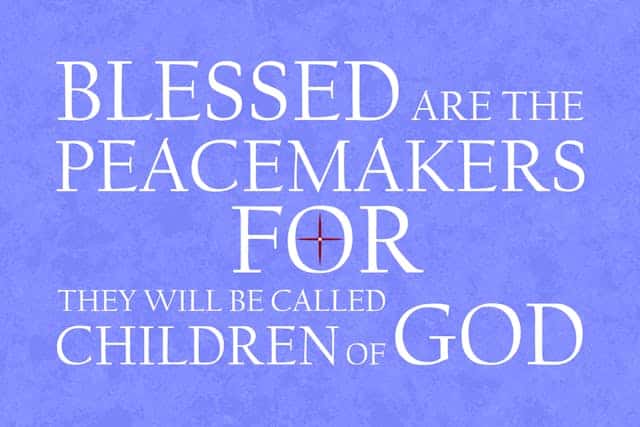
Jesus called us to be peacemakers. When he climbed up on that hillside and preached “blessed are the peacemakers, for they shall be called children of God” he was calling us to live a certain kind of life, individually and collectively. He was commanding us to adhere to a way of being in the world characterized by an extravagant love of neighbor, a wide mercy, and a generosity of spirit and service. He was imploring us to actively build communities where those same values are realized and upheld, and to resist any powers of evil that would deny justice or prevent the blossoming of a true and lasting peace.
That call to peacemaking is an absolute imperative in this moment when our own nation’s leaders are choosing the words and ways of war. We must choose peace.
[Author’s Note: I wrote and published this blog post the day before Charlie Kirk was killed by a sniper at an event in Utah and two children were injured in a school shooting in Evergreen, Colorado. My concern about a growing rhetoric of war and violence grows, and I continue to call us to the urgent work of peacemaking.]
The Reverend Shari Prestemon began her service with the national ministries of the United Church of Christ in January 2024. As the Associate General Minister & Co-Executive for Global Ministries she has the privilege of overseeing several teams: Global Ministries, Global H.O.P.E., Public Policy & Advocacy Team (Washington, D.C.), and our staff representative to the United Nations. She previously served as pastor to local UCC congregations in Illinois and Wisconsin; the Executive Director at the UCC’s Back Bay Mission in Biloxi, Mississippi; and as Conference Minister in Minnesota.
Related News
It Started with a Haystack: An Evolution of Ministry Around the World
ABCFM. How’s that for some more alphabet soup in the United Church of Christ? ABCFM...
Read More
What Matters Most to Us?
When it comes to the decisions we make in our churches about how we will steward our...
Read More
Disasters in Paradise
Three years. In disaster recovery terms, that’s nothing. Just shy of three years...
Read More