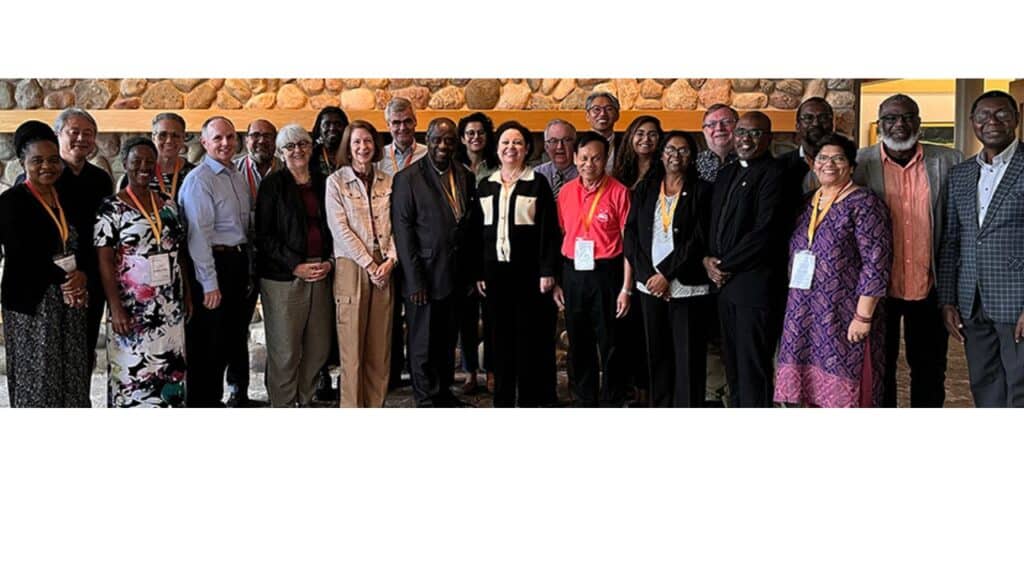
World Communion of Reformed Churches visits U.S., members urged to ‘persevere in witness’
The United Church of Christ recently welcomed delegates from the World Communion of Reformed Churches (WCRC) to its downtown Cleveland offices, where UCC team members discussed with their international partners the latest global, gender, climate, economic, and racial justice initiatives happening abroad and domestically.
Delegates, representing 233 member churches across 105 countries, also had the opportunity to talk with UCC General Minister and President Rev. Karen Georgia Thompson about the current state of the world.
“There’s a global perspective to the many issues we face,” said the Rev. Mark Pettis, UCC ecumenical and interfaith relations manager. “We made sure our staff connected with the members of the WCRC.”
The visit from the Hannover, Germany-based organization — just one of the many global partners UCC works with in creating and supporting justice-seeking and unity-building ministries — was not only an opportunity to share information. It also allowed both organizations to foster communication and strengthen relationships — which are “important in the work being done in creating a ‘just world for all,’” said Pettis.
Pettis added, too, that in all these conversations there is always the question to be answered: “How are we living out our covenantal relationships?”
“How do we go beyond discussions and take action?” he said.

A week prior to its Cleveland visit, the executive committee of the WCRC was in Grand Rapids, Michigan for a meeting held May 18-22 at Calvin University — the very place where the WCRC was established in 2010. Attendees were called upon to “prayer, action and preparation.”
Taking a stand against Christian nationalism
Amid conversations on fostering a just communion, covenanting for justice, and doing theology for transformation, the WCRC also adopted its Executive Message Statement entitled, “Persevere in Our Witness.” (Read the entire message here.)
The statement condemned Christian nationalism, citing that “Christian nationalism, rising authoritarianism, and the scourge of racism are tearing at the core of this nation.”
Helping to inform and shape the Executive Message Statement were presentations from experts on such issues, including talks from Calvin University history professors Kristin DuMez and James Bratt.
The statement, though, was not U.S.-centric. It also noted global challenges and called for those “working for truth and justice throughout the world” to act by petitioning governments to establish an immediate ceasefire in Gaza, demilitarize the Korean Peninsula, cease arms sales to Israel, end the embargo against Cuba, enact measures to counter the climate catastrophe and develop humane immigration policies for migrants. Other actions included committing to engaging in dialogs “for deeper understanding of our responsibilities as witnesses to the liberation love of Jesus Christ.”
Plans are now underway for the WCRC General Council to be held Oct. 14-23, 2025, in Chaing Mai, Thailand. The theme will continue that of the May 2024 Executive Message Statement, calling for members to persevere in their witness.
Content on ucc.org is copyrighted by the National Setting of the United Church of Christ and may be only shared according to the guidelines outlined here.
Related News
Creation Justice: How people in Memphis have been taking action against hyper-scale data centers
When Alexis Humphreys began working on a grassroots effort to confront Elon Musk’s xAI data...
Read More
The good old church dinner gets reimagined as hunger and loneliness rise: Free meals are life-saving ministries
She was one of many who came forward to the communion table, taking with her two tiny cups...
Read More
National Ministries, along with Central Pacific Conference release joint statement condemning school shooting in Bend, Oregon
The United Church of Christ, in collaboration with the Central Pacific Conference, has...
Read More