No Judgment Zone
These days, it seems the lines are drawn in the sand with rigidity when it comes to political alliances and religious categories like progressive, liberal, moderate, evangelical and conservative. These words are bandied about in discussions about people and who they vote for, and they are used in the church to describe variations in Christian theological beliefs. Somewhere along the way, it seems the religious and the political have become intertwined with expectations that individuals who self-identify in a category hold a particular line on theological and political beliefs consistently. This has resulted in stereotyping based on theological and political beliefs.
By definition, a stereotype is a fixed, oversimplified idea or belief about a particular type of person, group, or thing that ignores individual differences. Stereotyping becomes layered on the practice of checking boxes to categorize people upon encounter. The initial categorization is based on what can be readily seen: race, age, gender, height, weight, appearance all contribute to checked boxes which are not always accurate and complicate the ability to form and nurture relationships. Stereotypes can create barriers to getting to know the people who are present in community or communities in which an individual participates. Judgment is leveled before interactions begin, resulting in misunderstanding and miscommunication. The commitment to “do no harm” is violated in the presence of stereotypes.
The inability to be in conversation across the political and theological divides in the United States contributes to the adherence to the use of stereotypes in determining relational value, oftentimes denying the possibility of relationship with individuals suspected of thinking differently. The stereotypes themselves fuel misinformation and disinformation about groups, their practices and beliefs pitting progressives, conservatives, and moderates against each other.
In the United Church of Christ, the use of these terms is challenging. The denomination is understood to be progressive, having clear General Synod resolutions on issues from abortion, ordination of queer people and women, and taking clear and forward-thinking stances on issues well before they are status quo. These are commitments to justice and inclusion, ensuring that the voice of the denomination is advocating for communities that find themselves marginalized with the confines of dominant culture narratives.
Yet the denomination continues to have a membership who runs the gamut of the theological and political spectrum. People choose to be present with the values and commitments of the denomination, bringing with them the realities of their lives and their beliefs. Can the denomination find ways to make room for all at the table, fostering and nurturing the hard conversations needed to transcend the stereotyping that is pervasive? Or will it succumb to the will to judge rather than listen and interrogate the assumptions attached to the labels people are given? There is no expectation that all will agree on every issue, yet there is an expectation that respect and communication will assist in bridging the divide.
For example, while some hold inclusion as a progressive value, there are self-identified progressive people who do not believe in inclusion, holding to the need for excluding individuals they believe do not belong. There are the assumptions that every self-identified conservative is a Trump supporter, is anti-LGBTQ, and subscribes to nationalistic values. And there is an expectation based on the box checked that all related issues will be supported. Similar lines are drawn for progressives with expectations that all who self-identify as progressive will support a similar set of issues.
Perhaps it is time to have the hard conversations that will dispel the labels dispensed freely and often without credibility. The hard conversations can be had between individuals who begin with the desire to care for each other as an essential to their daily living and have the common commitment to “do no harm”.
All people are not the same. The difference held can be a source of personal and communal learning and growth. Across the United Church of Christ. congregations and their members are navigating these relationships, discussing common commitments, and sharing in ministry and mission, while holding different opinions on a myriad of issues.
The church has been co-opted along the way to support the judgments created by stereotypes. The voice of the church has been aligned with anti-democratic and nationalistic values. There are those who look on and see that as the church in the United States, making no distinction between the labels that denominations, congregations or members hold. That, too, is stereotyping.
Members of the church risk its prophetic edge when they choose not to distinguish themselves from the status quo, when the choice is silence amid social ills. Members of the church risks its call to unity when the choice is to fall into the will of the day to see those it does not agree with or those labeled as other as enemy to be pushed aside. The church should be a no judgement zone, a place where people can come as they are, be who they are, and live the commandment to love God and love neighbor as self.
Jesus did say: Judge not that you be not judged.
Content on ucc.org is copyrighted by the National Setting of the United Church of Christ and may be only shared according to the guidelines outlined here.
Related News
As Chicago Theological Seminary ends 170 years of educating ministry leaders, talks to affiliate with Yale Divinity School get underway
Chicago Theological Seminary (CTS) and Yale Divinity School (YDS) have announced a proposed...
Read More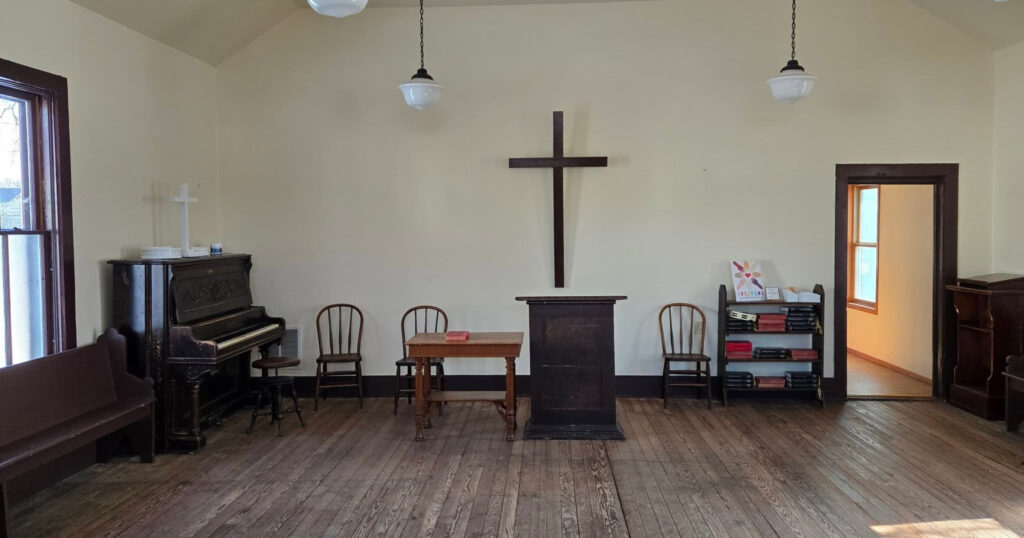
‘An act of love’: A UCC church’s commitment to preserve and share African American history in South Dakota town
A small, 140-year-old African Methodist Episcopal (AME) Church in Yankton, South Dakota, was...
Read More
No Judgment Zone
These days, it seems the lines are drawn in the sand with rigidity when it comes to political...
Read More