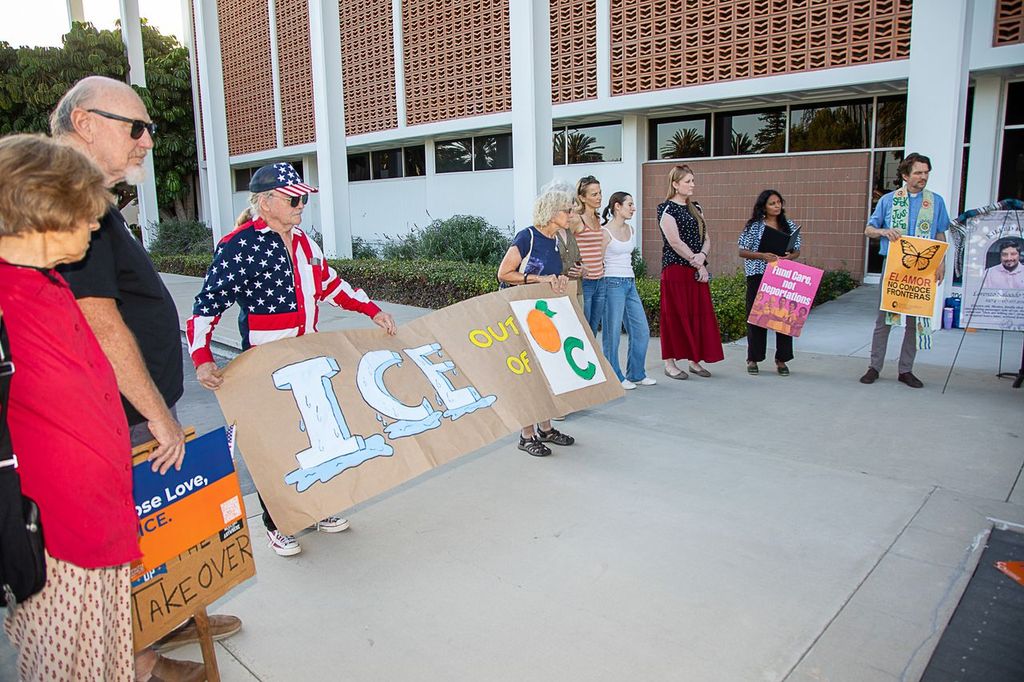
As ICE injustices escalate, so do acts of faith and witness
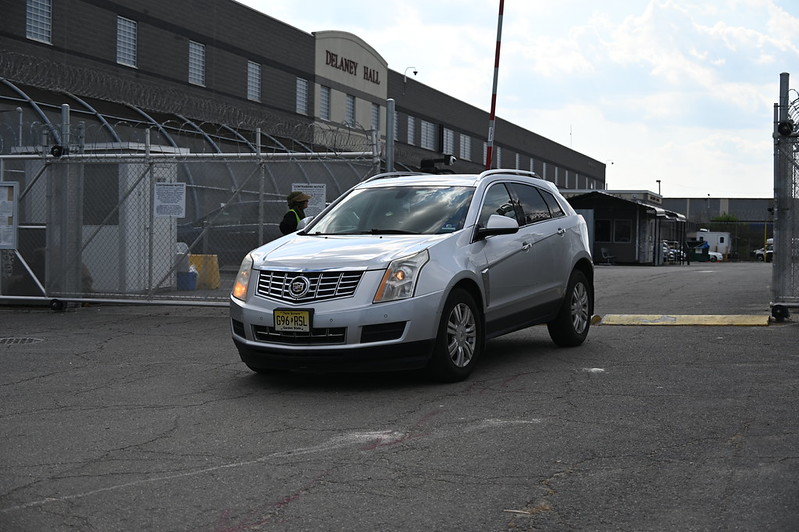
With temperatures rising to triple digits and 18-wheelers barreling down Newark, New Jersey’s potholed industrial roads, United Church of Christ clergy descended upon the Delaney Hall detention facility.
They were part of Faith in New Jersey’s “All Roads Lead to Delaney,” an act of witness that brought together a hundred religious leaders — all giving voice to those being held inside the largest immigration facility on the East coast. Delaney has an estimated authorized capacity of 1,196.
A sense of urgency punctuated the July 13 event, having come on the heels of the fatal shootings by Immigration and Customs Enforcement (ICE) agents of Lorenzo Salgado Araujo in Houston, Texas, and Joan Sebastian Durán Guerrero in Biddeford, Maine.
Compelled to go
The Rev. Jack Cuffari, pastor of First Congregational Church of Haworth, New Jersey, admitted to feeling “compelled” to go even as a close lawyer friend advised against it.
“He stressed to stay out of the way of the agents, but I needed to go,” said Cuffari, blaming the 1960s activist blood flowing through his veins. “I was raised not to be quiet about these things,” he added.
Cuffari had been to Delaney before, and each time his lawyer friend’s contact information has been inked on his arm. On one such visit, the pastor, whose path to the UCC was a circuitous one — with stops among the Quakers and Presbyterians — radically prayed for the “other.”
No, not the detainees.
“I talked about praying for the Delaney guards and the ICE agents, and for us to realize they are children of God, and how damaged they must be to be in that kind of work. No one is beyond redemption,” said Cuffari, mindful of how counterintuitive his words might have sounded.
Yet, by doing so, Cuffari reminded those present of Jesus’ hardest ask of the faithful: To pray for those who persecute you.
Delaney de je vu
Delaney Hall opened its doors as an ICE detention center in 2011. Six years later, through the efforts of tireless advocates, the battle to close it was won. Delaney was then transformed for a time into a half-way house.
But in May 2025, the GEO Group, a for-profit prison corporation, reopened Delaney Hall. It was a move that startled and saddened clergy.
“The reopening caught us off guard,” said the Rev. Katrina Forman, lead pastor of the Union Congregational Church in Montclair, New Jersey.
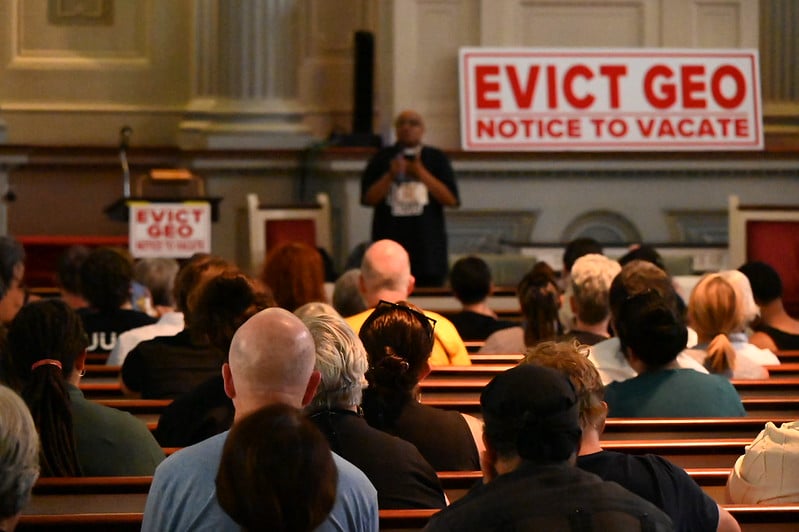
While the 2017 closure victory was short lived, it didn’t deflate Forman’s holy hopes. The pastor joined the “All Roads Lead to Delaney” crowd and, as the summer sun strengthened, so did the prayers of lament and the chants to “evict GEO now.”
It was the communal singing on site, though, that touched Forman deeply. Specifically, hearing the words to “Hold On,” which was written by Heidi Willis in response to the January ICE shooting of Renée Good and sung in the streets of Minneapolis.
With the words urging the world to “hold on, hold on my dears, the dawn is coming,” Forman watched as the “All Roads Lead to Delaney” participants tied banners to the chain link fences. The banners were graced with monarch butterflies symbolizing migration and transformation.
Holding on
For faith leaders, the July 13 presence at Delaney Hall was not a one and done event. Faith in New Jersey, observes Forman, stepped in for on-going action, centering future work around the stories of the people who are detained and their families.
“There’s a lot a noise about what protesters are doing outside and what ICE is doing inside, but our faith calls us to listen — and listen well — and to remain focus on what’s important. Families are being ripped apart, and our neighbors are being stripped of their dignity and human rights,” said Forman.
A small, yet meaningful step in restoring dignity were the hospitality tents erected outside the Delaney Hall gates.
On July 12, the Rev. Annie Allen of the Rutherford Congregational Church, Rutherford, New Jersey, took to social media, giving viewers a tour of the tents that provided shade from the sun, refreshments, and medical and mutual aid assistance. There was also a wardrobe tent with changing rooms providing family members with Delaney approved clothing.
“Restrictions have gotten tighter and those visiting loved ones don’t realize they will not be allowed inside if, for example, you are wearing sandals,” explained Forman.
Not far, yet …
Ten miles. That is the distance between Forman’s congregation in Montclair and Delaney Hall in Newark.
“Not far, yet a world away,” said Forman, acknowledging the insulated bubbles affluent suburbs like Montclair tend to be in when it comes to the fight for immigration justice.
“We are a town of 40,000 people, mostly liberal, who think perhaps that people getting taken from the streets can’t happen here,” she said.
But it can. And it does.
“I know there are families in my children’s school who have a parent in Delaney. These kids are going through trauma that is not talked about in the news,” said Forman.
This past Lent, as her congregation delved into the theme of pilgrimages, Forman had an idea to move past the talk and get to the action: To embark on a 10-mile pilgrimage from Montclair to Newark.
Word quickly spread. On Good Friday, April 3, more than 300 people — half UCC members from 12 churches across New Jersey — laced up their sneakers for a pilgrimage to Delaney.
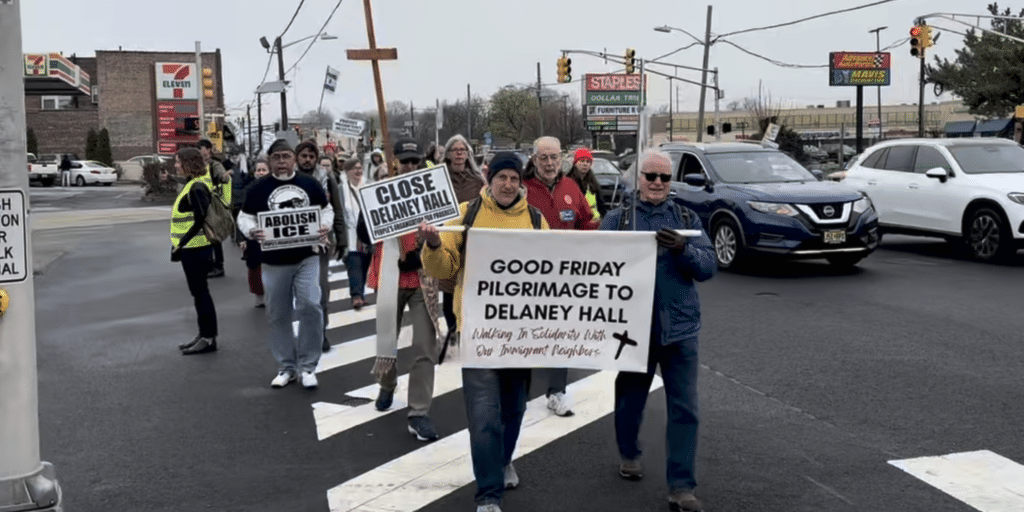
For Forman, the pilgrimage was not just a protest, it was embodied prayer.
“So often we fall into the trap of separating justice and worship. This was an act of witness and solidarity,” said Forman, adding, “It was also a beautiful reminder that we in the United Church of Christ have a vital role to play in this moment.”
Joining Forman on the pilgrimage were her children — ages 5 and 8.
“They walked the last two miles,” said the proud pastor mom, admitting it has been a struggle as a parent to know how much and what to share with children.
“We need to build in them empathy. The pilgrimage sparked some good conversations,” said Forman.
Beyond good conversations, pastors like Forman realize that many congregations want to move away from feeling powerless. They want to know how they can be peacemakers and justice seekers.
From powerless to powerful
To start, Forman offered, congregations need to realize no one is immune to ICE activity.
“This is happening everywhere. It is something that is tearing at the seams of community,” she said.
Congregations, she suggested, can begin looking up the number of people who have been detained in their states. Find out the names of detainees and speak those names in the prayers of the people rather than lifting a generic pray for “those imprisoned.”
Forman also offered congregations take a cure from “All Roads Lead to Delaney” where strips of ribbons in the colors of the monarch butterfly — red, orange, yellow — were imprinted with names of those taken, missing, or killed, and tied to Delaney’s fence.
“Create a display of ribbons in the sanctuary or outside on church property. That is one way we can show there are people who care and who recognize what is being done to others is not just an atrocity, but a violation of God’s will,” said Forman. “There are immigrants in every community in the country. Show your love and care and witness for them. Show that they are not alone.”
Butterflies and vigils
Among the next step Faith in New Jersey is taking is the creation of a toolkit to be released later this summer. In the kit will be a monarch butterfly stencil, which was introduced to “All Roads Lead to Delaney” participants. The idea, said Forman, is to mark the places where people have been seized by ICE with a butterfly as a tangible reminder of what took place.
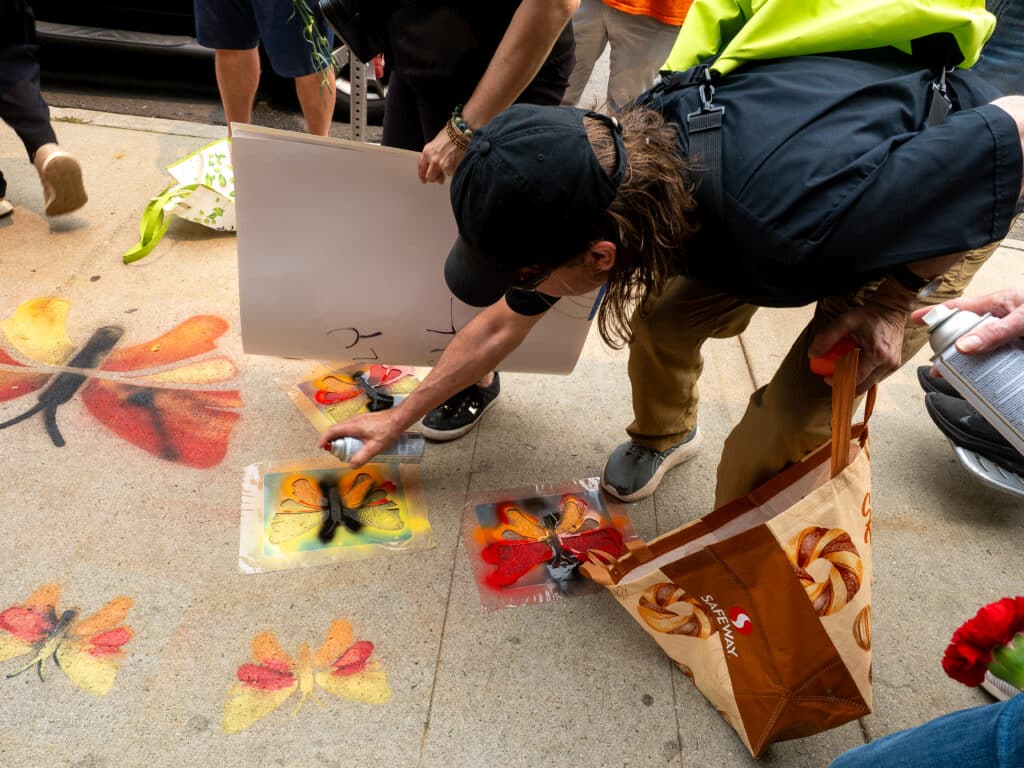
“The hope is to have the monarch butterflies spread across the country, making visible what is happening,” said Forman.
And with ICE arrests surging to record highs this summer, so will the work and witness of the faithful.
On July 19, Live Oak United Church of Christ in Brea, California, co-sponsored with neighboring houses of faith a flower vigil to remember the murders of Lorenzo Salgado Araujo and Joan Sebastian Guerrero. Amid singing, prayers, moments of silence and calls for accountability, participants gathered outside Fullerton City Hall and placed flowers beneath large displays featuring photographs of the two men.
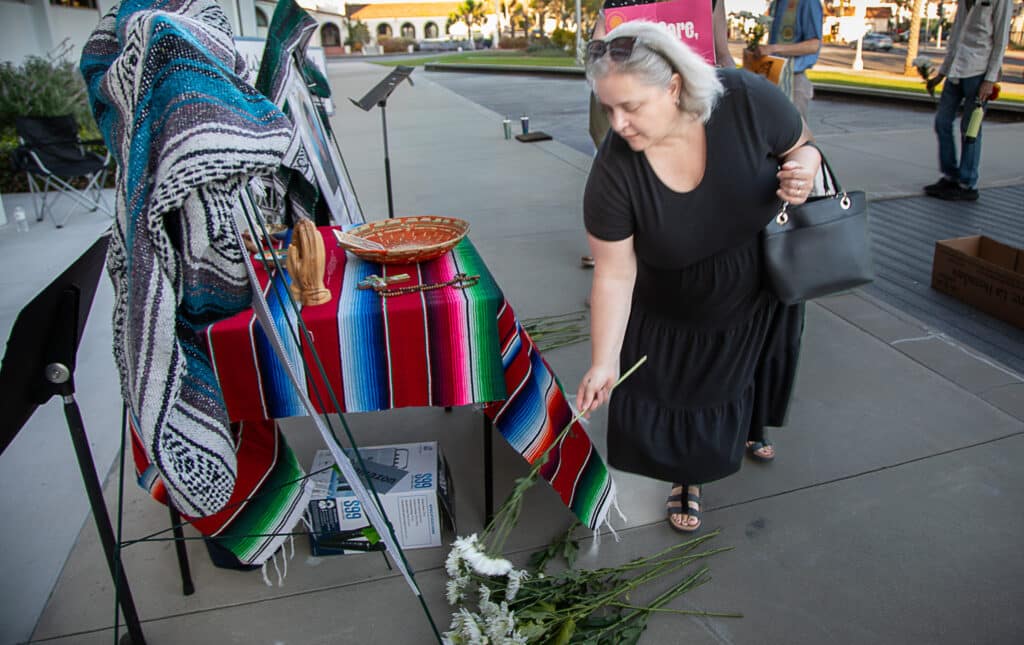
Attending the vigil was the Rev. Noel Andersen, who leads the UCC in immigration advocacy and is a National Field Director for Church World Service. He said that communities can longer remain silent, especially considering the escalation of ICE arrests.
“We need to continue the vigils, the protests, and calling our members of Congress,” said Anderson.
Faith leaders in Texas also came together on July 20, calling for state officials to use their authority to end ICE violence. Among them was the Rev. Dr. Dan De Leon, senior pastor of Friends Congregational Church, College Station, Texas, who drew from the Sermon on the Mount, stressing that Jesus said “blessed are the peacemakers” — not the peacekeepers.
“Keeping the peace is what ICE alleges to be doing in communities, but immigration and customs enforcement policies that are carried out by dehumanizing, criminalizing, and endangering our immigrant neighbors make for a fake peace, a forced peace, the kind of Pax Romana — the Roman Empirical peace — that Jesus stood against, and that we, the people, have no interest in keeping,” shared De Leon.
Back in New Jersey, Cuffari also seeing a rise in the children of God standing up for the “other.”
“It is a hopeful thing seeing white, middle-class suburbanites [North New Jersey’s key demographic] leaving their homes, their comfort zones, and taking a stand at Delaney. It not just one march or protest, but they are showing up to bring food, to rinse the eyes of those who got tear gassed,” said Cuffari. “These acts are not typical of a middle-class existence.”
For Forman, those who stood shoulder to shoulder at Delaney had in a way created in a way a spiritual shift.
“Delaney Hall is in this industrial wasteland, and in so many ways it is a site of all that is wrong with the world,” said Forman. “But feeling the vibrations of how people of faith can come together and shift what a space feels like, well, we remind ourselves that this, too, can be sacred space if we treat it is as such.”
Content on ucc.org is copyrighted by the National Setting of the United Church of Christ and may be only shared according to the guidelines outlined here.
Related News
National Ministries, along with Central Pacific Conference release joint statement condemning school shooting in Bend, Oregon
The United Church of Christ, in collaboration with the Central Pacific Conference, has...
Read More
‘No death should be fodder for public entertainment’ – Rev. Karen Georgia Thompson issues statement on the initial intention of the live broadcast of the execution of Nidal Malik Hasan
The United Church of Christ’s General Minister and President/CEO, the Rev. Karen Georgia...
Read More
We Are Not Alone
A Tent of Our own Making is a series of gatherings in the United Church of Christ where...
Read More